
Tips on properly sizing the combustion air openings
Can the boiler breathe?
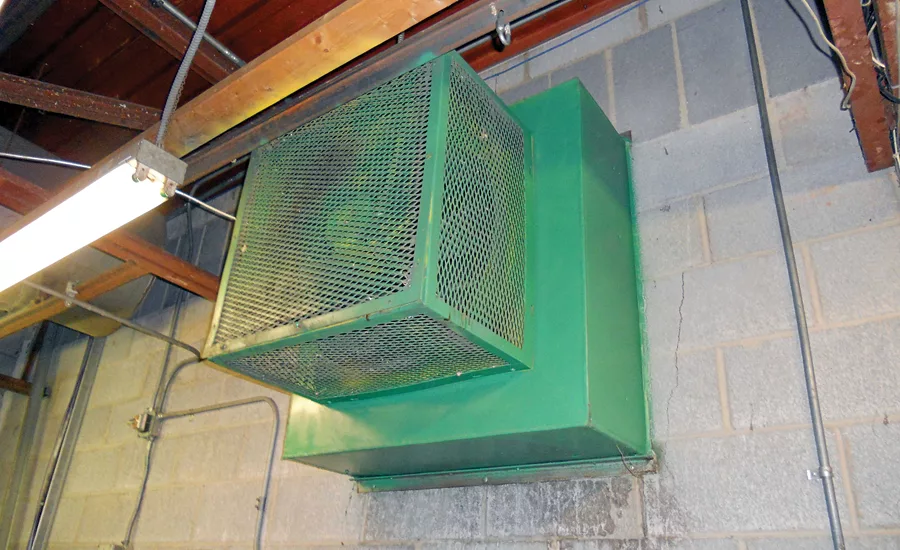
Exhaust fans in boiler rooms can pull the flue gases from the burner into the main building. Photo credit: Ray Wohlfarth
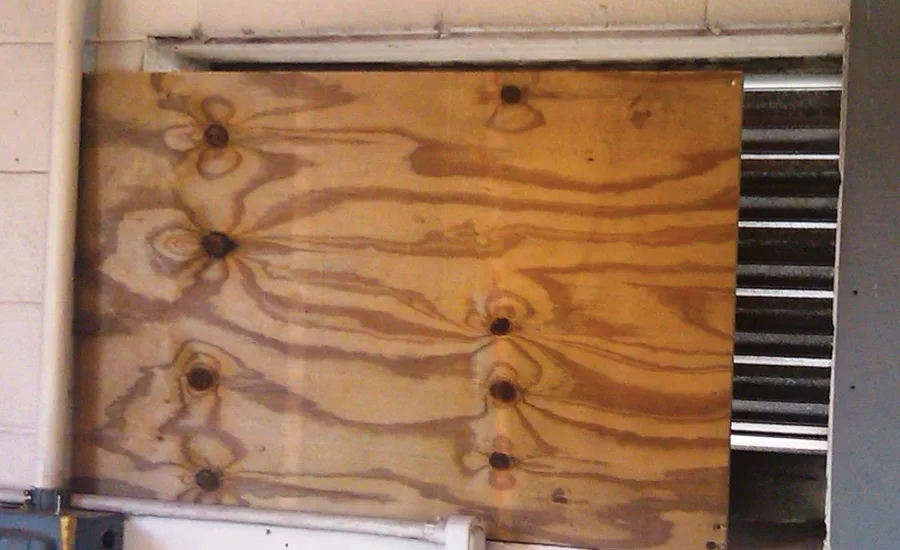
When combustion air openings are blocked, such as this one, boilers and water heaters can be starved of air. Photo credit: Ray Wohlfarth
I was a young apprentice working with a journeyman technician in a boiler room and he explained how to determine the combustion air required for a boiler room.
He measured the existing louvers and calculated the free area of the opening using a tablet and a pencil. The free area of an opening determines how much combustion air can be delivered to the boiler room. After completing his calculations, he announced the existing grill was too small for the boiler room. He pulled out a hammer from his metal tool box and broke one of the glass panes from the window.
“There,” he said proudly. Just at that time, the owner walked into the room.
“What are you doing?” he demanded.
“Didn’t have enough combustion air so I fixed it,” the journeyman said.
It was the first and only time I was ordered to leave a jobsite. The journeyman was fired by the boss and I was reprimanded. Although the journeyman was wrong in his decision to break the glass without the owner’s permission, he instilled in me the importance of checking the combustion air openings on every service call. As a grizzled old boiler room veteran now, I see many boiler rooms with inadequate combustion air.
According to the International Fuel Gas Code, Section 304, each boiler room should have two openings, one within a foot of the floor and one within a foot of the ceiling. This is to allow natural ventilation inside the boiler room. The dual openings also limit the possibility of a single opening being blocked and starving the boiler or water heater for air. I see many boiler rooms with the combustion air opening accidently blocked by either leaves or garbage or purposely blocked by wood or cardboard.
Sizing
The International Fuel Gas Code requires the following combustion air openings for a boiler room:
-
Vertical opening. One-inch free area for each 4,000 Btu/hr. input of gas burning appliances in the room.
-
Horizontal duct opening. One-inch free area for each 2,000 Btu/hr. input of gas burning appliances in the room.
-
Mechanical fan. One CFM of air for each 2,400 Btu/hr. input of gas burning appliances in the room.
-
Indoor air. 50 cu. ft. of area for each 1,000 Btu/hr. of the appliances.
To properly size the combustion air openings, add the input of all fuel burning equipment inside the boiler room. Let us assume we have a 40 gal., 40,000-Btu/hr. water heater and a 200,000 Btu/hr. boiler for a total of 240,000 Btu/hr. in a room with two vertical openings with metal louvers:
-
240,000 Btu/hr. per each openings equals 120,000 Btu/hr. per each opening.
-
240,000 divided by 4,000 Btu/hr. equals 60-in. of free area required.
If we assume the free area of each metal louver to be 75% of the total size, we would need two grills each sized at 80 sq. in. each.
If we open a 10-in. by 10-in. hole in the wall, we will have a 100-sq.-in. opening. That would not be a good thing as critters and birds could come into the room. So we install a metal louver with a screen in the opening. This will not deliver the same amount of air as a wide-open hole because of the restrictions of the louvers and screen.
The louver manufacturer should be able to provide you with the actual free area or aK factor of the louver. If it is not available, I use a factor of 75% free area for metal louvers so our free area of the 10-in. by 10-in. opening is now 75 in. instead of 100 in. That opening would be large enough for 300,000 Btu/hr. The following are some rules of thumb on free area for other combustion air openings:
-
Wooden louvers – 25% free area
-
Metal screens – 98% free area
-
Motorized dampers – 95% free area
Mechanical ventilation
If you opt to use a fan for mechanical ventilation, you will need 1 CFM for every 2,400 Btu/hr. You also will need an interlock to verify the fan is operating before the boiler or water heater starts.
Many residential boiler installations are relegated into a small closet and expected to work properly. When using indoor air for combustion, the boiler room should have 50 cu. ft. of volume per 1,000 Btu/hr. of fuel burning components. If the same system as above is using indoor combustion air instead of outside air, the following is the size room we would need.
-
240,000 total Btu/hr. divided by 1,000 equals 240.
-
240 x 50 (cubic feet per 1,000 Btu/hr.) = 12,000 cu. ft.
Assuming we have a 12-ft., high ceiling, our boiler room would require an area of 1,000 sq. ft., or a boiler room roughly 32 ft. by 32 ft. If the room does not have that much space, you can install a combustion air fan to introduce air to the room. Wire the fan to operate any time the water heater or boiler is operating.
I have been inside many boiler rooms where the combustion air openings have been blocked. As a service technician, I believe we have a duty to explain to the owner the importance of combustion air. I offer to remove the blockage and if they refuse, will put something in writing advising them of the danger. If something happens, you were the last one there. I like to check the outside of the louvers to make sure they are clean and unobstructed. I have found them blocked by grass clippings, old newspapers and plastic shopping bags.
If the boiler room has an exhaust fan, it could adversely affect the venting of the flue gases. A mere -3/100 in. W.C. can pull the flue gases from an atmospheric burner or pilot. This could allow the dangerous flue gases into the building.
If you are using motorized combustion air dampers, ASME CSD1 code calls for an interlock on the driven damper to not start the boiler until the damper is open.
Make sure your boiler can breathe and stay safe.
This article was originally titled “Can the boiler breathe?” in the September 2016 print edition of PM Engineer.
Looking for a reprint of this article?
From high-res PDFs to custom plaques, order your copy today!


