Professional Plumbing Engineer Viewpoints | James Dipping
Getting serious on how hospitals are built
Calling all architects and code officials.
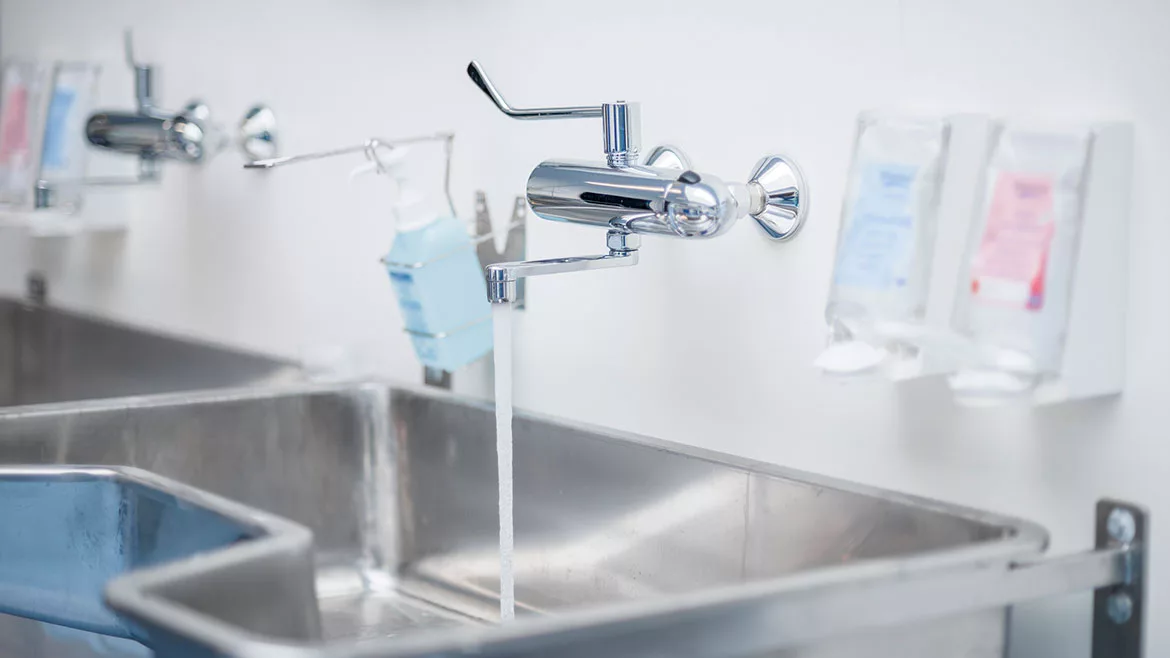
Image courtesy of silkfactory / iStock / Getty Images Plus
The health care landscape has changed over the last several years, and it is severely impacting a plumbing engineer’s ability to keep hospital patients safe within hospital and other health care buildings. What’s that change, you may ask? It’s that no one uses the plumbing fixtures code requires in many hospital and health care applications anymore.
I have discussed the need for smarter plumbing systems that improve system operation and water management strategies. I’ve been a proponent of “right-size” plumbing system strategies that many of my great colleagues have and are continuing to develop because it reduces water volume and surface area in our piping systems. I’ve discussed domestic hot water system temperatures based on building application and how it helps control Legionella growth. I’ve discussed supplemental disinfection and how, when properly employed, can be a great tool in further reducing Legionella development in a plumbing system and lowering legal risk for building owners and operators.
I’m not much of a New Year’s resolution person, but I’ve said to myself that I want to “keep it simple” in 2024. Not that I ever intentionally tried to make things complicated, but it’s more of a concerted effort to look at how things are done, and say —is there a better way? Sometimes there is, and sometimes there’s too much red tape to get through, but the idealist in me wants to try. So here we go:
When a plumbing engineer receives the design of a health care building — our minds gravitate to designing the system to optimize all the different considerations I mentioned above — with the fixture layout the architect has developed. But what if the layout changed? What if the amount of fixtures were reduced? If the following items could become more commonplace in health care design, it would drastically simplify the domestic water supply and return system allowing for a higher level of safety for building occupants.
Patient room staff sinks
Staff sinks in patient rooms are one of the most infrequently used plumbing fixtures in most hospitals today. This is thanks to the now common use of hand-sanitizing solutions. It has become common for hospitals to install hand sanitizing solution dispensers in every patient room; therefore, the staff sink that is intended for hand washing goes unused. What complicates this more is the water piping for the staff sink is typically remote from the patient room toilet. Staff sinks are typically at the patient room entry, and toilet rooms are at the patient room rear. Removing staff sinks in patient rooms can eliminate potentially hundreds of unused (and unnecessary) plumbing fixtures, and thousands of feet of water piping from the domestic water system.
Manufacturers have now developed shower fixtures that self-drain from the showerhead riser into the room, indicating there is awareness about stagnant water and infrequently used fixtures. While I applaud this design feature — it does help plumbing engineers provide clients with an improved design — when will building codes recognize that these fixtures aren’t used and no longer require them?
ICU showers and toilet fixtures
Most patients that are designated for an Intensive Care Unit are not ambulatory, so the plumbing fixtures within the ICU patient room often go unused except for Environmental Services Staff exercising the fixtures when cleaning the rooms.
For hospitals that have individual rooms for ICU patients, it’s common to see a water closet, shower, lavatory, along with the above-mentioned staff sink.
What is worth considering is to only have one lavatory in the room, and a shared water closet or clinical service sink for servicing bed pans (as most patients use a bedpan, and do not physically use the water closet). Patients in an ICU setting likely never use the provided shower. Staff treating patients in an ICU setting often contend with many tubes and wires attached to the patient, which makes mobilization a challenge and using a restroom very difficult.
Manufacturers have now developed shower fixtures that self-drain from the showerhead riser into the room, indicating there is awareness about stagnant water and infrequently used fixtures. While I applaud this design feature — it does help plumbing engineers provide clients with an improved design — when will building codes recognize that these fixtures aren’t used and no longer require them?
There are challenges with patient care in an ICU. Staff looks for short travel distances and increased visualization to patients, are tasked with mobilizing patients under extreme conditions and more. From a plumbing fixture standpoint, eliminating unused fixtures from the spaces can provide more space in the room, better visualizatio, and a safer, simplified plumbing system.
Exam room sinks
Much like staff sinks in hospital patient rooms — exam room sinks in medical office spaces seem to be very infrequently used by staff and patients alike. Doctors, nurses and technicians in a medical office space setting have all converted to hand sanitizing solution, leaving the exam room sink behind. As a patient myself recently, I find myself appalled at the idea of turning on the exam room sink. They are not intended for drinking water purposes and are never used for handwashing anymore. Eliminating them from medical office spaces would again offer a simplified and safer domestic water system and save hundreds to thousands of feet of piping in a typical medical office space setting.
I’m sure there are more opportunities regarding fixture elimination in health care settings that can go a long way toward simplified and safer plumbing systems. I like to think the three opportunities listed above are the “low-hanging fruit” that can easily be picked and have a significant impact.
Let’s see how we can raise awareness of this topic and push our code writers to consider options like this. I’m sure there are discussions to continue to have these fixtures and I want to hear them. Let’s talk more about this, and let’s develop solutions that work.
Looking for a reprint of this article?
From high-res PDFs to custom plaques, order your copy today!