
Legionella Prevention
Point-of-use water disinfection: a necessary public health solution
POU disinfecting systems represent a pragmatic and efficient approach to managing water safety.

Image courtesy of PeopleImages / iStock / Getty Images Plus.
Point-of-use (POU) water disinfection is not merely a public health measure — it can be an engineering solution integral to modern water system design, aimed at reducing the prevalence of waterborne diseases.
POU disinfection systems ensure the safety of potable water right where it is used, whether that be at a hand pump, shower or a kitchen sink. In the face of sobering statistics and advisories from authorities like the CDC and insights from the Gates Foundation, a global non-profit that works to help all people lead healthy, productive lives, POU disinfection systems provide realistic solutions to the significant health risks associated with contaminated water sources worldwide.
The Gates Foundation highlights a need for improved sanitation, noting that 3.5 billion individuals globally are exposed to the risks of waterborne pathogens due to inadequate sanitation systems. The CDC's estimates, while lower, still point to a staggering 2.5 billion people without access to improved sanitation, and approximately 780 million without access to safe water. Diarrheal diseases, often caused by unsafe water, are the second leading cause of death globally in children under five years of age, claiming the lives of nearly 485,000 children each year, underscoring the critical need for effective water disinfection practices.
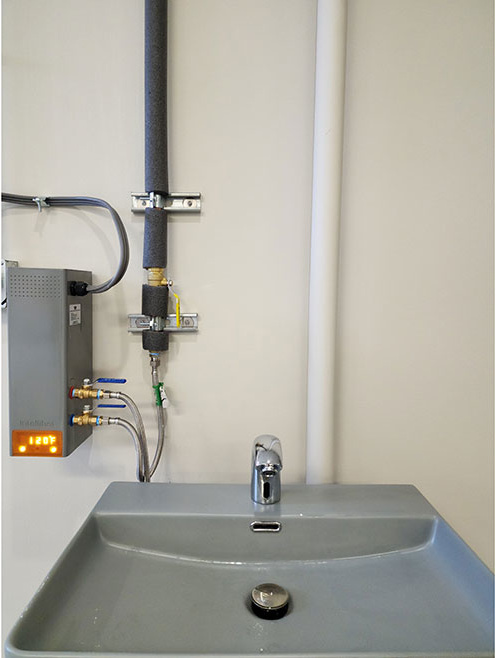
Intellihot's Legionator point-of-use system heats water but also disinfects it using Ozone. A set of high-quality quartz tubes heats water to a comfortable temperature. As the water is exiting the unit, ozone is injected into the water. This mitigates the pathogens in the water as well as the bacteria present within faucet valve seats and aerators. Image courtesy of Intellihot
These figures not only underscore the sheer volume of individuals at risk but also the potential impact of POU water disinfection systems in mitigating such risks. In regions where centralized water treatment is non-existent or unreliable, POU disinfection technologies can serve as a last line of defense against pathogens.
However, even the developed world is not immune to these challenges. Nations with advanced infrastructure can experience breaches in water quality due to system breakdowns, natural disasters, aging systems, or periods of stagnation within underused building s— situations we've encountered domestically with increasing frequency.
Lest you think these health issues don’t exist in the United States, according to the CDC, “The United States has one of the safest drinking water supplies in the world. Yet, the water we use for drinking, swimming and even cooling high-rise buildings can be safer. About 7.2 million Americans get sick every year from diseases spread through water.”
There is a wide array of POU disinfection technologies available for consideration, and clearly these technologies need to be matched to the resources and needs of the community being served. Technologies include:
- Boiling;
- Chemical dosing with chlorine or iodine;
- UV irradiation;
- Filtration through ceramic or advanced membrane system;
- Activated carbon treatment; and
- Ozone disinfection.
Ozone disinfection stands out for domestic POU applications due to its engineering advantages. The introduction of ozone gas into a water supply is a powerful intervention, offering a broad-spectrum solution against bacteria, viruses and protozoa, without the by-products associated with chlorination.
When ozone is injected into a water system, it performs a dual function: it acts as a disinfectant for the water itself, and as a means of disinfecting the internal surfaces of the water system. This is because when ozone is injected into a water supply, it travels down the plumbing system, helping to sanitize the plumbing components in the system. At the point of use, this means disinfecting the fixture necks, aerators and valve seats. This ability to inactivate biofilms and prevent their formation is particularly relevant in the context of Legionella control in complex building water systems, an issue also highlighted in the CDC report.
Here in the United States, where we typically have advanced public water systems, POU disinfecting systems represent a pragmatic and efficient approach to managing water safety. POU disinfecting systems are particularly useful with fixed flow fixtures, hand sinks, bar sinks and others, and can reduce infrastructure complexity and material use/construction costs. If localized at the point of use, disinfecting hot water systems can require less piping for several reasons:
- It may not be necessary to run hot water lines to all fixtures. Instead, run only cold water to a POU disinfecting water heater.
- Since there is no need for a return line, such lines can be safely removed from plans, saving additional construction costs.
- So called “dead legs” can be reduced or eliminated from plans, keeping water flowing more continuously through the remaining lines, eliminating stagnation.
However, the adoption of ozone POU systems and other disinfection technologies comes with challenges that must be recognized and addressed through design and planning. There are upfront costs, operational complexities, water volume limits and maintenance needs that must be factored into any implementation. This is where engineering expertise is essential — to devise systems that are not only effective but also economically and operationally sustainable.
Domestic education and community engagement play pivotal roles in the acceptance and proper maintenance of these disinfection systems. Public health benefits can only be realized if building owners and end-users understand the necessity of water disinfection and are equipped to manage the technology effectively.
The statistics from health organizations both domestically and globally should serve as our call to action, emphasizing the scope of the challenge and the critical importance of safe water access for everyone.
As plumbing engineers, we are positioned to tailor solutions that leverage various technologies to protect public health domestically and abroad. Just as the U.S. was a leader in eliminating cholera and typhoid from domestic water supplies in the previous century by turning to water treatment, so must we lead in using modern POU technology to do the same with waterborne diseases. By integrating POU water disinfection into broader water safety plans, we can make a measurable impact in the fight against waterborne diseases.
Looking for a reprint of this article?
From high-res PDFs to custom plaques, order your copy today!


