Pipe restoration for water quality
High-rise pipe restoration.
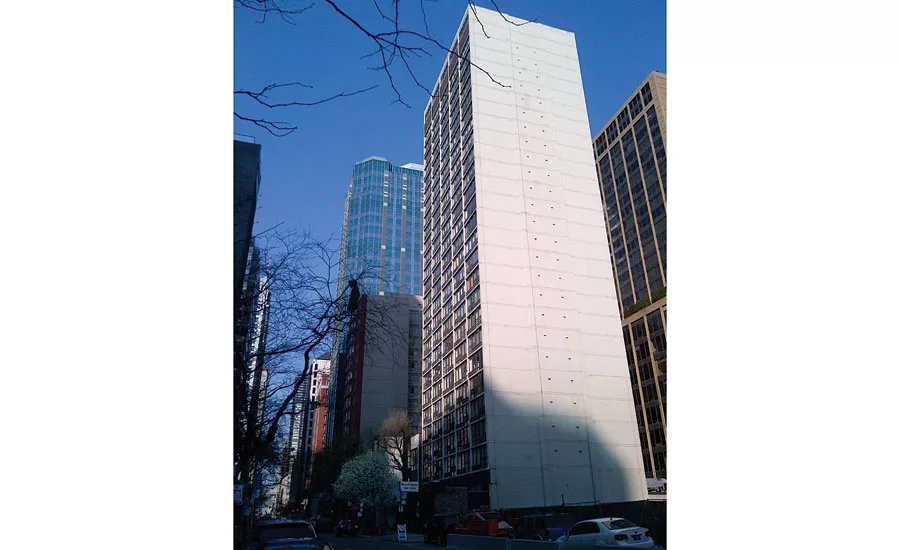
This 28-story condominium building in Chicago frequently experienced common failures associated with aged water pipes, such as rusty water and pinhole leaks.Photo credit: ACE DuraFlo

Condo residents were not displaced from their units thanks to the setup of water bypass systems so that residents always had water and ePIPE’s two-hour cure time. Photo credit: ACE DuraFlo
While a dramatic focus has been placed on water conservation and droughts across the western part of the country, an equal amount of concern should be placed on water contamination. As 15% of our water is lost through leaking pipes, a much higher percentage of water is contaminated by an array of scenarios, transforming supposed “clean” tap water into a health risk for many.
Investigations by the U.S. Environmental Protection Agency throughout past decades have found that a large proportion of waterborne disease outbreaks are attributed to pipe distribution systems. The ongoing, high-profile water controversy in Flint, Mich., where high levels of lead were found in the potable water, became a popular news story that thrust water contamination and lead-leaching into the national spotlight. Again.
And for good reason.
Although lead is a dangerous toxin and some believe no amount of lead is safe for consumption, it is estimated by the EPA that nearly 40 million Americans consume lead-contaminated water every day. And even though a small dose of copper is safe for humans to ingest, too much can cause serious health problems. Some North American water samples have found copper concentration 10 or more times the limit deemed safe.
Perhaps the majority of the public assumes that only 100-year-old buildings or residents of large cities encounter unsafe water contamination problems. But in reality, towns of all sizes, as well as buildings of all ages, can have leaking or corroding infrastructure systems that pose serious health problems or new piping with aggressive water that can leach metals into drinking water.
In additional, dangerous micro-organisms, bacteria and viruses can enter the water supply system through breaks in the distribution system, backflow, dormant water or as a result of traditional repairs on the piping system. Microbial contamination can cause disease or illness outbreaks to the public, such as Typhoid Fever and Legionnaires’ disease.
An economical solution
Since we can assert that, in some situations, replacing pipe and the lack of maintenance beforehand can cause water contamination problems, other solutions should be considered.
This is where pipe lining fits into the equation as a practical, economical and effective solution to stop and prevent water contamination while the water is making its way to the tap via supply piping.
Epoxy-coated pipe-lining technology introduces a thin, yet protective epoxy barrier coating to the interior of the water pipe so water does not touch the pipe. Independent research studies have designated epoxy coatings as an effective and safe method to rehabilitate pipes, prevent leaching of metals into the water supply, to hinder leaks and greatly increase the chance that clean water remains safe for consumption while on its long journey to the tap. Epoxy coatings for water pipe should be NSF/ANSI Standard 61-certified as a safe water system component.
This pipe restoration method is not new. Epoxy coatings have been utilized in other parts of the world for decades, and the technology was developed in the United States in the 1980s. But as is the case with any type of technology, innovative improvements throughout the years mean that pipe lining is being continuously enhanced.
Several epoxy coating manufacturers exist in North America today, each with products of varying advantages and uses. While each patented process remains slightly different, the majority follow the same approach for installation:
- An evaluation and diagnosis of the entire pipe system;
- Planning the pipe-lining process, mapping the pipe and equipment setup;
- Draining the water piping system and then drying by using clean, compressed air;
- Appling an abrasive agent to the pipe system (a cleaning process also known as sanding);
- Introducing the epoxy to the interior of the pipe system using compressed air, coating the pipe completely and letting the epoxy cure; and
- A thorough evaluation of the work performed, pipe system re-assembly and testing of the restored system.
Multifamily solution
The pipe-lining process is executed using existing access points and compressed air, which prevents the need for destruction or disruption to the property.
Restoring pipe systems with this technology has gained momentum within the property management, facility management and engineering industries. Pipe-lining systems can be installed in all types of buildings, from single-story homes to 35-story skyscrapers to nuclear power facilities. Not only does this in-place restoration process save money, time and inconvenience when compared with a traditional repipe, it greatly increases the useful lifespan of the pipe system and minimizes disruption to the building.
This was the case for the residents of 230 E. Ontario, a 28-story condominium building in Chicago who frequently experienced common failures associated with aged water pipe, such as rusty water and pinhole leaks. The residents were concerned for their health and safety because of the failing galvanized piping.
Discolored water is a sure sign of a failing pipe system. This process occurs when the zinc coating of the galvanized pipe erodes with time, allowing the galvanized steel to interact with the chemicals in the clean water, causing corrosion and rust. This rust affects the water and can ultimately restrict flow and water pressure. The residents in this Chicago condominium had good reason to be alarmed about the brown water coming from the tap.
The high-rise’s homeowners assocation board wanted a long-term solution to restore the building’s 40-year-old piping, but residents were not satisfied with the traditional repair options. These types of solutions would cause unsightly demolition to the building, resident displacement and a lot of construction expenses for a disruptive and long process. The board discovered ACE DuraFlo’s patented ePIPE pipe-lining technology and chose it as the ideal solution to restore and preserve the building’s hot and cold water risers, ranging from 1/2 in. to 3 in.
While the project commenced, Chicago had record-setting snowfall and extreme cold, which would have put a traditional repair on hold. Utilizing the ePIPE two-hour cure time, which is a faster cure time for small-diameter pipe-lining technologies approved for use in pressurized piping systems, the water piping was effectively cleaned and restored to a better-than-new condition. The ePIPE project was completed without causing resident displacement thanks to the setup of water bypass systems so that residents always had water.
The HOA board was satisfied with the work and the building has not had water-quality problems since the restoration project was completed.
Utilizing environmentally friendly, in-place pipe-lining technology is the progressive solution to water contamination problems.
If repiping could be symbolically depicted by the phrase, “Out with the old, in with the new,” then pipe lining can be illustrated with the phrase, “Restore the old, make better than new.”
This article was originally titled “High-rise pipe restoration” in the February 2016 print edition of Plumbing & Mechanical.
Looking for a reprint of this article?
From high-res PDFs to custom plaques, order your copy today!