
Thank Denis
A brief history of the steam pressure-relief valve.
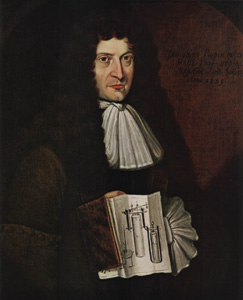
|
| Denis Papin |
In 1905, a boiler in a Boston shoe factory blew up, traveled a great distance through the air and landed, with delightful justice, in the front yard of the operating engineer’s house.
Think it got his attention?
Of course, this was at a time when just about everyone was burning coal and low-water cutoffs hadn’t been invented. High-pressure steam boilers were blowing up all across the land and a big reason for that had to do with the relief valves of the time. These were longish levers with a pivot point on the boiler end, a plug for the release of steam near the pivot point and an iron weight at the other end of the lever to keep the plug in place until it needed to pop.
The operating engineer could control the relief pressure of this crude device by moving the weight further out on the lever, or by adding more weight to the lever if the spirit moved him. Many did add weight because they did not want to lose the good head of steam they had worked so hard to build.
And that’s how you get a big boiler to fly through the air and land on your lawn.
This got me thinking about who was responsible for such an adjustable device as that early relief valve, and since I have way too much time on my hands, I set out to get the fellow’s story.
Which brings me to that grand Frenchman, Denis Papin. I think you’ll like him. I stumbled across him in the November 1912 edition of the Ideal Heating Journal, and this is his tale:
“It is a singular fact that the appetite for delicate foods was a prime motive in making steam the agency for comforting the human race during inclement seasons. Without the safety valve, steam heating could never have been made practicable, and it is, therefore, interesting to note the historical circumstances connected with the invention of the little valve which made it possible to handle steam pressures with safety, first, for cooking apparatus, then for both heating and power purposes.”
Isn’t that grand? It all begins with food! I find that delicious because I know the first hot-water heating system, invented by another Frenchman, Jean Simon Bonnemain, went into a huge chicken incubator in Paris during 1777.
Which means we can say that hydronic heating as we know it today began with a chicken.
But I digress. Listen again:
“The first safety valve was invented in 1681 by Denis Papin, a Frenchman, who was born at Blois, France, in 1647. He commenced his experiments on the phenomena of steam in July 1676, at London, under Robert Boyle, the distinguished Irishman who founded the Royal Society of London.”
Yep, that Robert Boyle. You know, the guy who came up with Boyle’s Law. We use that law a lot when we’re working with compression tanks. It’s the one that tells us about how when you squeeze air its pressure goes up, and vice versa. Oh, and after working for Robert Boyle, Papin went to work (as a letter writer) for Robert Hooke. Heard of him? Mr. Hooke built the vacuum pumps that Mr. Boyle used in his experiments. He also is the guy who first figured out that tiny particles, separated by great distances, make up air, and that when you heat matter, it expands.
Think of Hooke the next time you listen to copper fin-tube baseboard tick as the hot water hits it.
Other steam inventions
But back to the Journal:
“About 1780, Papin brought out a little steam apparatus called Papin’s Bone Digester for softening animal bones for ‘cookery, voyages at sea, confectionery, chemistry, and dyeing.’ Britain’s King Charles II ordered Papin to make a digester for his laboratory at Whitehall and the invention excited much interest. By means of this steam-pressure cooking machine, delicious jellies were made from beef, mutton and other bones.”
What king doesn’t want a pressure cooker? Charles II was a big eater. He was the king who followed 10 years of rule by that pesky Oliver Cromwell, who really knew how to stir up trouble. As a result of all that Cromwell craziness, Charles II went out of his way to keep peace in the valley. He set out to have a hedonistic era, during which he fathered a dozen illegitimate children and partied like a rock star, hence the need for the pressure cooker.
Hey, who doesn’t love a good meat jelly?
But there was one challenge:
“Enormous strength was needed in the machine to stand the high pressure generated, and Papin found that he could only make his machine successful by contriving a mechanical device that would release pressure at a certain point and thus prevent explosion. This he finally worked out during 1681 with the first steam-pressure safety valve. His machine could now be utilized without fear. A hundred years later, James Watt and others made use of his invention in connection with a steam-power engine and, later in the 18th century, Watt and other inventors made use of a similar contrivance to insure the safety of steam apparatus utilized for heating purposes.”
The next time you’re near a relief valve that pops, thank Denis.
And that’s not all the guy did. In 1690, he designed a one-cylinder steam engine and published an article about it. Six years later, he designed a pumping machine to raise water from mines. And you would think all that was good, right? But people are funny and some years later, that steam-engine business got him into trouble with Isaac Newton (the original Apple guy).
Stolen credit?
Thomas Newcomen, whom most credit with the invention of the steam engine (around 1710), based his design largely on what Papin had come up with in 1690. Thing is, Newcomen said he had never seen Papin’s design. And because Isaac Newton sided with Newcomen, Papin was on the outs with the Royal Society. He continued to send papers to the Society, which they would read, but never again publish.
So there.
The last we hear of Denis Papin is a letter that he wrote to Sir Hans Sloane on Jan. 23, 1712. Ever hear of Sir Sloane? He founded the British Museum and invented milk chocolate, which pleases me because it brings us, and delightfully so, right back to food.
Historians figure Papin died shortly after sending that letter. No one knows for sure. Neither do they know where or when he died. He is buried somewhere in an unmarked grave.
So there, part two.
His monument, however, is on yellowed paper in the form of the November 1912 edition of the Ideal Heating Journal, which concludes:
“Papin was one of the great benefactors of the human race. Living in the age of Pascal, Newton, Boyle and Leibnitz, he partook liberally of the spirit of progress, which was a work in those days to free the human race of its shackles imposed by ignorance of natural laws, and it may well be said that Papin ‘builded better than he knew.’ He was both a prophet and executor of mechanical progress and his memory is one of the sacred treasures of the power- and low-pressure, steam-heating industries.”
And now you also can remember him.
HELPFUL LINKS:
Looking for a reprint of this article?
From high-res PDFs to custom plaques, order your copy today!


