
Use Of Copper Connections Presses Forward
Contractors see consistency, labor savings and versatility as advantages of press fittings.

With the growing use of copper press fittings in the U.S. plumbing and hydronic heating market in the last decade, contractors say the pipe-joining method increases the consistency in their jobs while it reduces their labor hours. In addition, their crews are broadening the application of press fittings to commercial as well as residential jobs.
“I’ve seen a huge lack of consistency in soldered joints between technicians on a single job,” says Carl Geib, owner of First Choice Plumbing in Derby, Conn. “An experienced tech may be able to sweat hundreds of connections flawlessly, but it’s not likely that you’ll have the same results with a greenhorn who could be working an arm’s length away.”
The assurance of consistency enables All Seasons Plumbing & Heating in Homer, Alaska, to distinguish its work from its competitors, owner Rob Weinfurter says. He has been using press-fit technology such as Viega ProPress since starting his firm 10 years ago.
“All of my work is done with press-fit connections,” he says. “Customers, of course, expect my systems to work well, but what they get is something way beyond that because they see what other people’s boiler rooms look like. That’s when they see the difference immediately.”
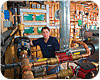
Dan Foley, president of Foley Mechanical in Alexandria, Va., agrees. He and the 18 professionals in his shop have been using press-fit connections for about six years.
“It’s like the old saying: ‘Quality goes in before the name goes on,’” says Foley, former president of the Radiant Panel Association. “And one of the key signature elements for us is the use of press-fit fittings.”
PHCC’s base labor-hour units reflect “everything that goes into an application - prep, installation and testing,” says John Zink, director of education and programs for PHCC.
Examples of base labor units drawn from PHCC’s manual show a time savings in the use of press-fit technology over solder. A 1/2-inch copper joint requires 0.2 hour to solder vs. 0.103 hour to press fit. A 1-inch copper T takes 0.75 hour vs. 0.369 hour to press fit.
In addition to the base labor units, PHCC has calculated a set of suggested adjustment factors that take into account jobsite conditions such as scaffolding, multistory buildings, and the distance between the installation and material stockpile. For example, if the stockpile is 300 feet away, a contractor would multiply 1.03 to the base labor unit.
Nick Nikpourfard, MCAA’s director of technical services, says the labor hours in MCAA’s Labor Estimating Manual (LEM) are developed by empirical formulas that consistently have been proven over many years to be accurate. These formulas are used to develop labor hours for all types of materials and joining methods, including press-fit connections.
“The LEM establishes a basic mode of communication for the evaluation and consideration of concepts with regard to estimating in the mechanical contracting industry,” he explains. “We use proprietary formulas, developed since the inception of the manual in 1970, to verify or, in some cases, modify manufacturer claims about time required to perform all varieties of tasks.”
Examples in MCAA’s LEM state that to join 3-inch type K copper pipe requires 0.11 hour for press fit vs. 0.15 for silver solder and 0.13 for grooved technology. To join 4-inch type M copper pipe requires 0.13 hour for press fit, 0.18 for silver solder and 0.15 for grooved.

“For us, time is money, and we don’t have enough of it,” Bilo says.
The time saved using press-fit connections is a key contributor to the company’s success, he notes, adding that it allows his firm to be competitive on labor when bidding jobs even though his techs are paid at a higher level. His crews also stay ahead of schedule, which Bilo says is a big asset on commercial jobs.
Brian Golden, senior technician for Foley Mechanical, says he uses press-fit technology almost exclusively now for commercial and residential hydronic installations. The sizes of the fittings range from 1/2-inch to 4 inches.
“I can remember a time when there used to be a moment of indecision when loading the truck,” he adds. “Do I take the torch, extra tank, solder, flux and sweat fittings? But not any more. We grab the press-fit fittings and cordless press tool and we’re ready to go.”
Viega Propress Connect
With the growing use of copper press fittings in the U.S. plumbing and hydronic heating market in the last decade, contractors say the pipe-joining method increases the consistency in their jobs while it reduces their labor hours. In addition, their crews are broadening the application of press fittings to commercial as well as residential jobs.
“I’ve seen a huge lack of consistency in soldered joints between technicians on a single job,” says Carl Geib, owner of First Choice Plumbing in Derby, Conn. “An experienced tech may be able to sweat hundreds of connections flawlessly, but it’s not likely that you’ll have the same results with a greenhorn who could be working an arm’s length away.”
The assurance of consistency enables All Seasons Plumbing & Heating in Homer, Alaska, to distinguish its work from its competitors, owner Rob Weinfurter says. He has been using press-fit technology such as Viega ProPress since starting his firm 10 years ago.
“All of my work is done with press-fit connections,” he says. “Customers, of course, expect my systems to work well, but what they get is something way beyond that because they see what other people’s boiler rooms look like. That’s when they see the difference immediately.”
Dan Foley, president of Foley Mechanical in Alexandria, Va., agrees. He and the 18 professionals in his shop have been using press-fit connections for about six years.
“It’s like the old saying: ‘Quality goes in before the name goes on,’” says Foley, former president of the Radiant Panel Association. “And one of the key signature elements for us is the use of press-fit fittings.”
Dan Foley,
president of Foley Mechanical in Alexandria,
VA
Labor-Hour Savings
Both the Plumbing-Heating-Cooling Contractors – National Association and the Mechanical Contractors Association of America compile estimates of labor hours required for various pipe-joining methods. Their manuals have included press fittings for about seven years.PHCC’s base labor-hour units reflect “everything that goes into an application - prep, installation and testing,” says John Zink, director of education and programs for PHCC.
Examples of base labor units drawn from PHCC’s manual show a time savings in the use of press-fit technology over solder. A 1/2-inch copper joint requires 0.2 hour to solder vs. 0.103 hour to press fit. A 1-inch copper T takes 0.75 hour vs. 0.369 hour to press fit.
In addition to the base labor units, PHCC has calculated a set of suggested adjustment factors that take into account jobsite conditions such as scaffolding, multistory buildings, and the distance between the installation and material stockpile. For example, if the stockpile is 300 feet away, a contractor would multiply 1.03 to the base labor unit.
Nick Nikpourfard, MCAA’s director of technical services, says the labor hours in MCAA’s Labor Estimating Manual (LEM) are developed by empirical formulas that consistently have been proven over many years to be accurate. These formulas are used to develop labor hours for all types of materials and joining methods, including press-fit connections.
“The LEM establishes a basic mode of communication for the evaluation and consideration of concepts with regard to estimating in the mechanical contracting industry,” he explains. “We use proprietary formulas, developed since the inception of the manual in 1970, to verify or, in some cases, modify manufacturer claims about time required to perform all varieties of tasks.”
Examples in MCAA’s LEM state that to join 3-inch type K copper pipe requires 0.11 hour for press fit vs. 0.15 for silver solder and 0.13 for grooved technology. To join 4-inch type M copper pipe requires 0.13 hour for press fit, 0.18 for silver solder and 0.15 for grooved.
Photos by Viega
Residential And Commercial
The 12 technicians at Ipswich, Mass.-based Bilo Plumbing & Heating save an average of 50 percent in time on boiler replacements using press-fit technology, President Brian Bilo says. His firm chiefly focuses on high-end residential work.“For us, time is money, and we don’t have enough of it,” Bilo says.
The time saved using press-fit connections is a key contributor to the company’s success, he notes, adding that it allows his firm to be competitive on labor when bidding jobs even though his techs are paid at a higher level. His crews also stay ahead of schedule, which Bilo says is a big asset on commercial jobs.
Brian Golden, senior technician for Foley Mechanical, says he uses press-fit technology almost exclusively now for commercial and residential hydronic installations. The sizes of the fittings range from 1/2-inch to 4 inches.
“I can remember a time when there used to be a moment of indecision when loading the truck,” he adds. “Do I take the torch, extra tank, solder, flux and sweat fittings? But not any more. We grab the press-fit fittings and cordless press tool and we’re ready to go.”
Links
Looking for a reprint of this article?
From high-res PDFs to custom plaques, order your copy today!


