
search
cart
facebook instagram twitter linkedin youtube
  • Sign In
  • Create Account
  • Sign Out
  • My Account
  • NEWS
  • PRODUCTS
    • FEATURED PRODUCTS
  • CONTRACTORS
    • BATH & KITCHEN PRO
    • BUSINESS MANAGEMENT
    • HIGH EFFICIENCY HOMES
    • TECHNOLOGY
    • WATER TREATMENT
    • PMC COLUMNS
      • Dave Yates: Contractor’s Corner
      • John Siegenthaler: Hydronics Workshop
      • Kenny Chapman: The Blue Collar Coach
      • Matt Michel: Service Plumbing Pros
      • Scott Secor: Heating Perceptions
  • ENGINEERS
    • CONTINUING EDUCATION
    • DECARBONIZATION | ELECTRIFICATION
    • FIRE PROTECTION
    • GEOTHERMAL | SOLAR THERMAL
    • PIPING | PLUMBING | PVF
    • PME COLUMNS
      • Christoph Lohr: Strategic Plumbing Insights
      • David Dexter: Plumbing Talking Points
      • James Dipping: Engineer Viewpoints
      • John Seigenthaler: Renewable Heating Design
      • Lowell Manalo: Plumbing Essentials
      • Misty Guard: Guard on Compliance
  • RADIANT & HYDRONICS
    • RADIANT COMFORT REPORT
    • THE GLITCH & THE FIX
  • INSIGHTS
    • CODES
    • GREEN PLUMBING & MECHANICAL
    • PROJECT PROFILES
    • COLUMNS
      • Codes Corner
      • Kristen R. Bayles: Editorial Opinion
      • Guest Editorial
    • SPONSOR INSIGHTS
  • MEDIA
    • EBOOKS
    • PODCASTS
    • VIDEOS
    • WEBINARS
  • RESOURCES
    • BIG BOOK DIRECTORY
    • REP LOCATOR
    • INDUSTRY CALENDAR
    • PM BOOKSTORE
    • CE CENTER
    • MARKET RESEARCH
    • CLASSIFIEDS
  • EMAGAZINE
    • EMAGAZINE
    • ARCHIVE ISSUES
    • CONTACT
    • ADVERTISE
    • PME EMAGAZINE ARCHIVES
  • SIGN UP!
Radiant & HydronicsThe Glitch & The Fix

What Difference Does It Make?
By John Siegenthaler, P.E.
An installer decides to use a buffer tank between a mod/con boiler and a highly zoned distribution system.

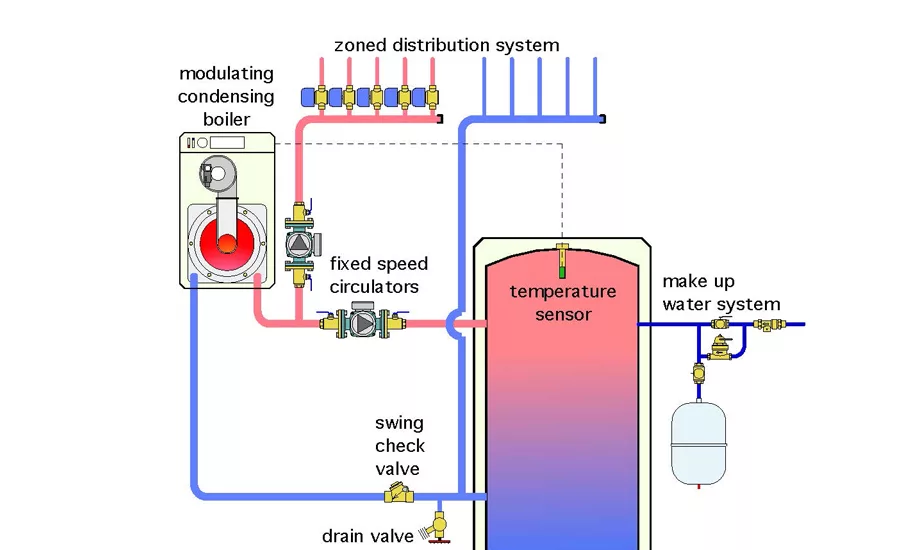
The Glitch. An installer decides to use a buffer tank between a mod/con boiler and a highly zoned distribution system.  They select and install the buffer tank and other hardware as shown in figure 1. 
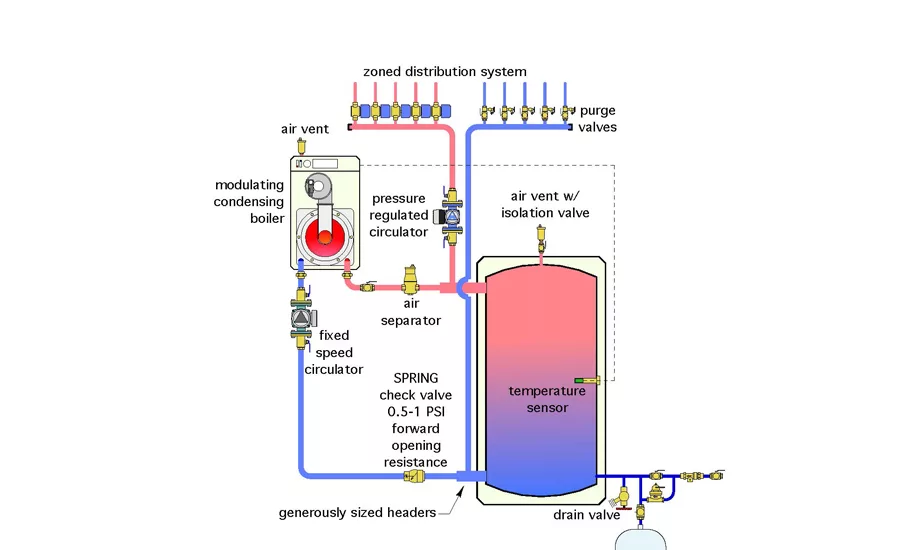
The corrections are all shown in figure 2.

The Fix: The corrections are all shown in figure 2.  

An installer decides to use a buffer tank between a mod/con boiler and a highly zoned distribution system.
The corrections are all shown in figure 2.
April 24, 2017

The Glitch:

An installer decides to use a buffer tank between a mod/con boiler and a highly zoned distribution system.  They select and install the buffer tank and other hardware as shown in figure 1.  The boiler is programmed to turn on when any zone is calling for heat, and the temperature sensor at the top of the buffer tank drops to 120 ºF.  The boiler turns off when the temperature at that sensor reaches 140 ºF, or if no zone is calling for heat.  The load circulator turns on whenever any zone circuit calls for heat.  Can you spot several errors or omissions in the proposed system?


Here’re a dozen goof ups in the original configuration.

1. The sidewall connections on the buffer tank are located well down from the top of the tank, and well up from the bottom of the tank.  This will leave the hottest and coolest water “stranded” in the tank, because the hottest water doesn’t “want” to come down from the top, and the coolest water doesn’t “want” to move up from the bottom.

2. The swing check valve in the boiler inlet pipe will not stop water returning from the load circuits from migrating through the boiler when it’s off.  This unnecessarily dissipates heat through the boiler enclosure and reduces the supply water temperature to the load circuit due to mixing at the upper tank header.

3.  The pipe sizes entering the sidewall connections on the tank are not increase relative to the boiler and load circuit piping.  Given the common practice of sizing piping in small hydronic systems for 4 feet per second velocity, the flow velocity entering the tank will be well above the suggest 2 feet per second limit.

4.  The make up water system could work as shown, but any cool water entering the tank would mix with what is likely to be hotter water, which tends to disrupt temperature stratification.

5.  The temperature sensor mounted at the top of the tank will tend to reach the temperature at which the boiler turns off before the water well below the sensor has reached this temperature.  It would be better to located the sensor at the mid-height of the tank.

6.  The drain valve will not allow water below the lower sidewall connect to be drained from the tank.

7.  The fixed speed circulator on the distribution system does not provide differential pressure control as zone valves open and close.  If a fixed speed circulator is used with valve-based zoning, a differential pressure valve should be installed.  Even better, use a variable speed pressure-regulated circulator and forget the bypass valve.

8.  The piping between where the load circuit connects to the tank headers is longer than necessary.  This will add head loss to the common piping path and decrease hydraulic separation between the circulators.

9.  There are no purging valves on the return side of the zone circuits.

10. The boiler circulator should be pumping into, not away from, any mod/con boiler (or other heat source) that has a relatively high flow resistance.

11.  There’s not central air separator in the system.

12.  There’s no air vent to let trapped air escape from the top of the buffer tank.


The Fix:

The corrections are all shown in figure 2. 

By the way, if you read April’s Hydronics Workshop column you probably identified many of the intension errors quickly.  If you haven’t read that column, please do so for a more complete explanation of the glitches and the fixes.

Check out What Difference Does It Make? in pdf form.

KEYWORDS: troubleshooting

Share This Story

Looking for a reprint of this article?
From high-res PDFs to custom plaques, order your copy today!

John siegenthaler 200x200

John Siegenthaler, P.E., is a consulting engineer and principal of Appropriate Designs in Holland Patent, New York. In partnership with HeatSpring, he has developed several online courses that provide in-depth, design-level training in modern hydronics systems, air-to-water heat pumps and biomass boiler systems. Additional information and resources for hydronic system design are available on Siegenthaler’s website,  www.hydronicpros.com.

Recommended Content

JOIN TODAY
to unlock your recommendations.

Already have an account? Sign In

  • 2025 Next Gen ALL-STARS hero 1440

    2025 Next Gen All Stars: Top 20 Under 40 Plumbing Professionals

    This year’s group of NextGen All-Stars is full of young...
    Plumbing & Mechanical Contractor
    By: Kristen R. Bayles
  • Worker using the Milwaukee Tool SWITCH PACK drain cleaner

    Pipeline profits: Drain cleaning, pipe inspection create opportunities

    Drain cleaning and inspection services offer lucrative...
    Plumbing News
    By: Nicole Krawcke
  • Uponor employee, Arturo Moreno

    The reinvestment in American manufacturing and training

    Plumbing & Mechanical Chief Editor Nicole Krawcke and...
    Plumbing News
    By: Natalie Forster and Nicole Krawcke
Manage My Account
  • Newsletters
  • Online Registration
  • Subscription Customer Service
  • eMagazine
  • Manage My Preferences

More Videos

Sponsored Content

Sponsored Content is a special paid section where industry companies provide high quality, objective, non-commercial content around topics of interest to the Plumbing & Mechanical audience. All Sponsored Content is supplied by the advertising company and any opinions expressed in this article are those of the author and not necessarily reflect the views of Plumbing & Mechanical or its parent company, BNP Media. Interested in participating in our Sponsored Content section? Contact your local rep!

close
  • HyperPure® PE-RT tubing
    Sponsored byLegend

    More Than One Right Answer: Rethinking PE-RT in Modern Plumbing Systems

Popular Stories

Electric toggle switch.

Seizing Control

An infographic with "Water Heater Shipment Data" over a chart.

AHRI Data Shows Water Heater Shipments Remain Soft in 2026

Contractor with Customers

What Plumbing and Mechanical Contractors Get Wrong About the Cost of Finding New Work

Download the FREE 2025 Water Conservation, Quality & Safety eBook

Events

August 4, 2026

Is Contractor Training a Cost Center or Your Most Overlooked Growth Engine?

In this webinar, you’ll learn how to reframe training as a measurable revenue driver by connecting contractor performance improvements to real business outcomes—like increased equipment sales, stronger margins, and greater share-of-wallet.

View All Submit An Event

Poll

Getting your new hire jobsite-ready

How long does it typically take to get a new hire jobsite-ready?
View Results Poll Archive

Products

The Water Came To A Stop

The Water Came To A Stop

See More Products
eBook | 2025 Radiant & Hydronics All Stars

Related Articles

  • Guest Editorial
    'Where Does It All Go?'

    See More
  • Any System Beats No System, Or Does It?
    Al Levi

    See More
  • The 7-Power Contractor

    Al Levi: Attitude versus behavior: What’s the difference?

    See More

Related Products

See More Products
  • what hydronics taught holohan.jpg

    What Hydronics Taught Holohan: A Memoir of Life in the Heating Industry

  • Lessons Learned Servicing Boilers

See More Products
×

Keep your content unclogged with our newsletters!

Stay in the know on the latest plumbing & piping industry trends.

JOIN TODAY!
  • RESOURCES
    • Advertise
    • Contact Us
    • Directories
    • Store
    • Want More
    • Supply House Times
  • SIGN UP TODAY
    • Create Account
    • eMagazine
    • Newsletter
    • Customer Service
    • Manage Preferences
  • SERVICES
    • Marketing Services
    • Reprints
    • Market Research
    • List Rental
    • Survey/Respondent Access
  • STAY CONNECTED
    • LinkedIn
    • Facebook
    • Instagram
    • YouTube
    • X (Twitter)
  • PRIVACY
    • PRIVACY POLICY
    • TERMS & CONDITIONS
    • DO NOT SELL MY PERSONAL INFORMATION
    • PRIVACY REQUEST
    • ACCESSIBILITY

Copyright ©2026. All Rights Reserved BNP Media, Inc. and BNP Media II, LLC.

Design, CMS, Hosting & Web Development :: ePublishing