Think about the “long game” when designing or installing hydronic systems. Make the system’s as easy as possible to service. Those who follow will appreciate and respect you for doing so.
An installer is planning a multi-zone floor heating system supplied from a single stage non-modulating geothermal heat pump. Can you identify at least four design flaws or operational issues that are likely to develop if the system is installed as shown?
What if your boiler system could automatically switch between heat sources based on energy cost? A closer look at staging logic, relays and smarter system control.
When comparing hydronic systems designs that are common in North America with typical European equivalents, comparisons reveal details that would be beneficial in either market, but are not “traditional” in one market or the other.
Figure 1 shows a hydronic system that’s intended to supply four panel radiators, each with their own thermostatic radiator valve and an indirect water heater from a gas-fired sectional cast-iron boiler. The system is designed using primary/secondary piping. The primary circulator operates whenever the space heating load or the indirect water heater call for heat.
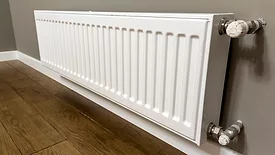
Panel radiators operated at low water temperatures, and with minimal fins attached to the rear of the water plate, can emit upwards of 50% of their total output as radiant heat.
In hydronic systems, the circuit usually passes through the boiler, which adds heat. When using a block heater and the boiler is off, it dissipates heat from the circuit. This heat loss must be considered when measuring the circuit's true "net" heating output.