Sizing Grease Interceptors
Think
in terms of gpm and gallons when installing grease interceptors.

 “Grease
interceptor” is an overall product category in much the same way as “faucets.”
I’m sure you can think of several types of faucets such as kitchen, bathroom
and tub faucets, to name a few.
“Grease
interceptor” is an overall product category in much the same way as “faucets.”
I’m sure you can think of several types of faucets such as kitchen, bathroom
and tub faucets, to name a few.
So while there may be many different designs of grease interceptors, there are two basic design principles used for separating FOG (fats, oil and grease) from wastewater. To avoid confusion, a consensus of the industry specifiers and plumbing officials with the leadership of IAPMO designated in 2006 new names for two types of grease interceptors:
The hydromechanical grease interceptor design incorporates air entrapment, the buoyancy of grease in water and hydromechanical separation with interior baffling for FOG separation. Hydromechanical grease interceptors continuously separate the FOG at the velocity it enters the interceptor.
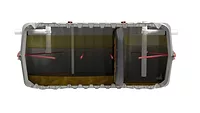
The gravity grease interceptor design incorporates two or more compartments in series, a minimum volume of 300 gallons and uses its larger volume of water to slow the flow velocity down, allowing the time required for the buoyancy of FOG in water to cause separation. As a result, the gravity grease interceptor is that much larger than the hydromechanical grease interceptor.
Although both types accomplish the same task, correct installation and sizing are critical in both types for proper grease separation. The key to proper sizing is understanding the “size” nomenclature, since it is different for each type.
The gravity grease interceptor size nomenclature is in gallons, based on the actual volume of water the interceptor will hold. Common sizes available today are 300, 500, 750, 1,000, 1,250, 1,500, 2,000 and 3,000 gallons.
Although the designs differ in separation methods and size nomenclature, the system parameter that must be known for proper sizing is the same. That parameter is the expected maximum flow in gpm that the grease interceptor will receive.
With the flow determined, hydromechanical grease interceptor sizing is very straightforward. You match the calculated flow in gpm to the size on the interceptor, which is marked in gpm. Hydromechanical grease interceptors, as with most plumbing devices, are performance-tested to national standards. The standards for hydromechanical grease interceptors are PDI G101 and ASME A112.14.3. Hydromechanical grease interceptors are tested at their rated flow, which is their size designation. In other words, a 20-gpm size is tested with a 20-gpm flow of grease-laden water. With an expected maximum flow of 20 gpm, you would use a 20-gpm-size interceptor.
To size a gravity grease interceptor with the flow determined in gpm, you simply multiply the flow number by a detention time, 30 minutes (the time period normally excepted for the grease to separate by buoyancy). Again with our 20-gpm example, the size would be 20 x 30 = 600. A 600-gallon size interceptor would be used.
Gravity grease interceptors sized with DFUs could see peak flow in excess of the sizing, resulting in a decrease in detention time. At some point, reducing detention time will affect grease separation efficiency.
The other challenge in sizing a grease interceptor is the facilities where the actual fixtures are not known. This can happen at a build-out at a mall where the square footage is designated for a restaurant, but the type is not known and there is a potential to change restaurants in the future.
Grease interceptors are often required to be incorporated in the basic building before occupancy is known. All that may be known at this point to size the interceptor is the drain pipe size that will discharge to the grease interceptor.
Again, there are two schools of thought for determining expected flow in gpm, which is needed to size either type of grease interceptor.
The first school of thought is that the maximum flow would be a full pipe with gravity flow. Based on standard engineering calculations, full-flow, 1/4 pitch, by gravity would approximately be 20 gpm for a 2-inch pipe; 60 gpm for a 3-inch pipe; 125 gpm for a 4-inch pipe; 203 gpm for a 5-inch pipe; and 375 gpm for a 6-inch pipe.
The second school of thought is that in a properly designed drainage system, the pipe will never be more than 50 percent of full capacity.
When using the first school of thought, both types of grease interceptors will perform properly - neither one will be undersized.
Using the second school of thought, if flows do exceed 50 percent, the hydromechanical grease interceptor will control the flow so grease separation is not compromised, but fixture drain down time will be extended. With the gravity grease interceptor, retention time will be decreased, reducing grease removal efficiency.
So is bigger better? Not necessarily. At one time, gravity grease interceptors were sized by both flow and expected retained solids, which made them larger, needing less frequent cleaning. Actual field experience has now shown us that over-sizing can result in the generation of hydrogen sulfide gas and sulfuric acid, destroying the interceptor and drainage system. So there is no pat answer for grease interceptor sizing. Sound engineering judgment should be applied to each system design.
So while there may be many different designs of grease interceptors, there are two basic design principles used for separating FOG (fats, oil and grease) from wastewater. To avoid confusion, a consensus of the industry specifiers and plumbing officials with the leadership of IAPMO designated in 2006 new names for two types of grease interceptors:
- Hydromechanical grease interceptor.
- Gravity grease interceptor.
The hydromechanical grease interceptor design incorporates air entrapment, the buoyancy of grease in water and hydromechanical separation with interior baffling for FOG separation. Hydromechanical grease interceptors continuously separate the FOG at the velocity it enters the interceptor.
The gravity grease interceptor design incorporates two or more compartments in series, a minimum volume of 300 gallons and uses its larger volume of water to slow the flow velocity down, allowing the time required for the buoyancy of FOG in water to cause separation. As a result, the gravity grease interceptor is that much larger than the hydromechanical grease interceptor.
Although both types accomplish the same task, correct installation and sizing are critical in both types for proper grease separation. The key to proper sizing is understanding the “size” nomenclature, since it is different for each type.
Think Differently
In plumbing valves, piping and fixtures, it is common to size a product by its inlet connection pipe size. This, however, is not true with either type of grease interceptor. The size of hydromechanical grease interceptors is expressed in the gallons per minute flow that the grease interceptor can accept and still remove 90 percent-plus of FOG from the influent. The common sizes available today are 10, 15, 20, 25, 35, 50, 75 and 100 gpm.The gravity grease interceptor size nomenclature is in gallons, based on the actual volume of water the interceptor will hold. Common sizes available today are 300, 500, 750, 1,000, 1,250, 1,500, 2,000 and 3,000 gallons.
Although the designs differ in separation methods and size nomenclature, the system parameter that must be known for proper sizing is the same. That parameter is the expected maximum flow in gpm that the grease interceptor will receive.
With the flow determined, hydromechanical grease interceptor sizing is very straightforward. You match the calculated flow in gpm to the size on the interceptor, which is marked in gpm. Hydromechanical grease interceptors, as with most plumbing devices, are performance-tested to national standards. The standards for hydromechanical grease interceptors are PDI G101 and ASME A112.14.3. Hydromechanical grease interceptors are tested at their rated flow, which is their size designation. In other words, a 20-gpm size is tested with a 20-gpm flow of grease-laden water. With an expected maximum flow of 20 gpm, you would use a 20-gpm-size interceptor.
To size a gravity grease interceptor with the flow determined in gpm, you simply multiply the flow number by a detention time, 30 minutes (the time period normally excepted for the grease to separate by buoyancy). Again with our 20-gpm example, the size would be 20 x 30 = 600. A 600-gallon size interceptor would be used.
Determining GPM
The sizing methods are rarely disputed. The difference of opinion is in determining the gpm flow that the grease interceptor should be sized to handle. When the actual grease-producing fixtures are known, one school of thought is to calculate the total gpm based on the total of all the volumes of the fixtures draining in one minute, plus the total of other fixtures that have a designed flow rate. This would be the peak flow rate for the facility. The other school of thought is to use DFUs (drainage fixture units) assigned to each fixture by the plumbing code and use what would be an average flow rate. Sizing to potential peak flow rate will work for both types of grease interceptors. Sizing to DFUs for hydromechanical grease interceptors can result in peak flows beyond the size chosen and result in extended drain down time for fixtures. But since the hydromechanical grease interceptor has a vented flow control, the designed flow will not be exceeded and the FOG removal efficiency will not be compromised.Gravity grease interceptors sized with DFUs could see peak flow in excess of the sizing, resulting in a decrease in detention time. At some point, reducing detention time will affect grease separation efficiency.
The other challenge in sizing a grease interceptor is the facilities where the actual fixtures are not known. This can happen at a build-out at a mall where the square footage is designated for a restaurant, but the type is not known and there is a potential to change restaurants in the future.
Grease interceptors are often required to be incorporated in the basic building before occupancy is known. All that may be known at this point to size the interceptor is the drain pipe size that will discharge to the grease interceptor.
Again, there are two schools of thought for determining expected flow in gpm, which is needed to size either type of grease interceptor.
The first school of thought is that the maximum flow would be a full pipe with gravity flow. Based on standard engineering calculations, full-flow, 1/4 pitch, by gravity would approximately be 20 gpm for a 2-inch pipe; 60 gpm for a 3-inch pipe; 125 gpm for a 4-inch pipe; 203 gpm for a 5-inch pipe; and 375 gpm for a 6-inch pipe.
The second school of thought is that in a properly designed drainage system, the pipe will never be more than 50 percent of full capacity.
When using the first school of thought, both types of grease interceptors will perform properly - neither one will be undersized.
Using the second school of thought, if flows do exceed 50 percent, the hydromechanical grease interceptor will control the flow so grease separation is not compromised, but fixture drain down time will be extended. With the gravity grease interceptor, retention time will be decreased, reducing grease removal efficiency.
So is bigger better? Not necessarily. At one time, gravity grease interceptors were sized by both flow and expected retained solids, which made them larger, needing less frequent cleaning. Actual field experience has now shown us that over-sizing can result in the generation of hydrogen sulfide gas and sulfuric acid, destroying the interceptor and drainage system. So there is no pat answer for grease interceptor sizing. Sound engineering judgment should be applied to each system design.
Looking for a reprint of this article?
From high-res PDFs to custom plaques, order your copy today!