
HVAC In A Bottle
GeoColumn system promises smaller
footprint and bigger energy savings over conventional ground-source heat pumps.
Rising energy costs, global warming and rapidly improving technology are opposing forces that are conspiring, one might say, to change the way we will heat and cool our buildings in the near future. This “warms race” is the impetus behind one innovation - the GeoColumn, a hybrid HVAC system that claims to improve upon two proven, but not always perfect, heating and cooling technologies.
The GeoColumn is a proprietary, “off the shelf” system that offers the benefits of direct exchange (DX) ground source heat exchangers, which produce heat from the surrounding earth, but it eliminates the costly and often difficult excavation or deep-well drilling these systems require. GeoColumns also promise the efficiency of heat pump systems, which literally create heat from thin air, but which also frequently disappoint owners by failing to produce enough heat when temperatures fall too far.
Invented by GeoEnergy Enterprises, an energy technology firm with a decade of ground-source experience in its ranks, the GeoColumn is a self-contained ground source heat pump that does not require ground water, water pumping or anti-freeze agents to function. And unlike other ground source systems, it can be installed in a relatively small space for new home construction and light commercial projects.
“Our goal is to get the benefits of geothermal heat exchange systems to as many consumers as possible,” says company president Tony Penachio.
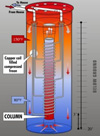
The GeoColumn comes housed in a sealed vessel just 28 inches in diameter. Inside this container, a gas heat exchange medium circulates through coils of copper tubing submerged in ordinary, unconditioned water. The entire system is buried in a borehole just 23 feet deep, which can be easily dug by light, truck-mounted drilling equipment.
According to Penachio, GeoColumns are also easy to set up - local HVAC crews can do it without special training or equipment - and the system requires little maintenance over its anticipated long service life. Buyers who want to convert existing heating and cooling systems have another incentive, Penachio adds. “GeoColumns are priced to compete with the cost of conventional oil, gas or propane HVAC systems.”
In a GeoColumn, the copper tubing used for the heat exchanger has a longer lifespan than systems that use plastic in-ground tubing. In addition to being a highly durable and sustainable or “green” material, copper’s superior conductivity and thermal transfer capability make it ideal for this application.
The Federal Economic Stimulus Bill defines geothermal heat pump systems as “energy property” and provides tax credits plus a 50 percent bonus depreciation for commercial installations. The bill also provides a 30 percent tax credit to homeowners for residential installations.
“This new technology has a tremendous economic up-side,” says Andy Kireta Jr., vice president of building construction for the Copper Development Association. “It can help reduce our dependence on fossil fuels and the amount of carbon emissions released into the atmosphere. And the new tax incentives make choosing a geothermal system even more cost effective.”
Fore more information, visit www.geoenergyusa.com.
Rising energy costs, global warming and rapidly improving technology are opposing forces that are conspiring, one might say, to change the way we will heat and cool our buildings in the near future. This “warms race” is the impetus behind one innovation - the GeoColumn, a hybrid HVAC system that claims to improve upon two proven, but not always perfect, heating and cooling technologies.
The GeoColumn is a proprietary, “off the shelf” system that offers the benefits of direct exchange (DX) ground source heat exchangers, which produce heat from the surrounding earth, but it eliminates the costly and often difficult excavation or deep-well drilling these systems require. GeoColumns also promise the efficiency of heat pump systems, which literally create heat from thin air, but which also frequently disappoint owners by failing to produce enough heat when temperatures fall too far.
Invented by GeoEnergy Enterprises, an energy technology firm with a decade of ground-source experience in its ranks, the GeoColumn is a self-contained ground source heat pump that does not require ground water, water pumping or anti-freeze agents to function. And unlike other ground source systems, it can be installed in a relatively small space for new home construction and light commercial projects.
“Our goal is to get the benefits of geothermal heat exchange systems to as many consumers as possible,” says company president Tony Penachio.
The GeoColumn comes housed in a sealed vessel just 28 inches in diameter. Inside this container, a gas heat exchange medium circulates through coils of copper tubing submerged in ordinary, unconditioned water. The entire system is buried in a borehole just 23 feet deep, which can be easily dug by light, truck-mounted drilling equipment.
According to Penachio, GeoColumns are also easy to set up - local HVAC crews can do it without special training or equipment - and the system requires little maintenance over its anticipated long service life. Buyers who want to convert existing heating and cooling systems have another incentive, Penachio adds. “GeoColumns are priced to compete with the cost of conventional oil, gas or propane HVAC systems.”
In a GeoColumn, the copper tubing used for the heat exchanger has a longer lifespan than systems that use plastic in-ground tubing. In addition to being a highly durable and sustainable or “green” material, copper’s superior conductivity and thermal transfer capability make it ideal for this application.
The Federal Economic Stimulus Bill defines geothermal heat pump systems as “energy property” and provides tax credits plus a 50 percent bonus depreciation for commercial installations. The bill also provides a 30 percent tax credit to homeowners for residential installations.
“This new technology has a tremendous economic up-side,” says Andy Kireta Jr., vice president of building construction for the Copper Development Association. “It can help reduce our dependence on fossil fuels and the amount of carbon emissions released into the atmosphere. And the new tax incentives make choosing a geothermal system even more cost effective.”
Fore more information, visit www.geoenergyusa.com.
Links
Looking for a reprint of this article?
From high-res PDFs to custom plaques, order your copy today!