Selecting A Thermometer
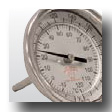
Bi-metal
When selecting a thermometer, it is important to consider the dial or case size, stem or capillary length, and the connection type and temperature range. To ensure safety and accuracy, thermometers should be selected while giving consideration to the measured media and the ambient operating conditions. Improper application may be detrimental to the thermometer, causing failure and possible personal injury or property damage.
While there are 3 basic operating types of thermometers, they being bimetal, liquid-in-glass, and Bourdon tube, the list can really be expanded to also include RTD and solar digital thermometers. All five types may appear suitable for any typical applications, however, the correct selection depends upon the industry being served and the application specified.
The following will serve as a general overview of each of these thermometers.
Bi-metal Thermometers
Bi-metal thermometers are direct sensing instruments. They are hermetically sealed and therefore, completely waterproof. All bi-metal thermometers are made of stainless steel to protect against corrosive conditions.How they work: Two different metals with different coefficients of thermal expansion are bonded together. As temperature changes, the unequal expansion of the two metals will cause the bimetal strip to curl, causing a displacement. This displacement is transferred from a ridged shaft to a delicate spring that drives the pointer.
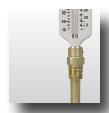
Liquid-in-glass
Liquid-in-glass Thermometers
Also known as liquid expansion thermometers, liquid-inglass thermometers are perhaps the most popular type of thermometer. There are two types of liquid-in-glass thermometers: industrial and laboratory.How they work: These thermometers indicate pressure by measuring expansion and contraction (i.e. as the fill liquid is heated, it expands and rises). The temperature is indicated on the vertical scale next to the fill liquid in the glass tube.
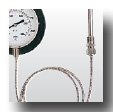
Remote Reading
Remote Reading Thermometers
By means of a capillary tube with a sensing probe at one end and an indicating dial on the other, temperatures can be determined from a source that is up to 30 feet (100m) away.How they work: The capillary of the thermometer is filled with a gas or vapour. As temperature changes, the gas or vapour expands/contracts, creating pressure that is measured by a Bourdon tube. Some of the most common capillary fills are nitrogen (in gas thermometers) and isobutene (in vapour thermometers). Consider factors such as ambient temperature, humidity, installation, indoors or outdoors, presence of dust, corrosive atmosphere, mechanical shock, frequency and magnitude of vibration.
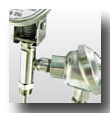
RTD
RTD (Resistance Temperature Detector)
When an application requires remote reading capability combined with high accuracy, a Resistance Temperature Detector (RTD) may be the best option.How they work: RTDs work by reading the resistance charge across a metal wire that is produced from each temperature input. RTDs can be supplied with a transmitter fitted inside the RTD head to provide an industry standard 4-20mA output signal.
Solar Digital
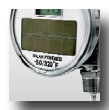
Solar Digital Thermometers
Digital readouts are sometimes preferred in some industrial environments. Electronic sensing thermometers are both available with digital readouts and solar powered.How they work: The temperature reading is captured by a sensor that relays the data to a digital display. No additional power supply is required to power these thermometers. These thermometers require between 16 to 35 lux of illumination.
For more information on thermometers or other industrial instrumentation, contact your distributor or visit www.winters.com/supporttools.
Looking for a reprint of this article?
From high-res PDFs to custom plaques, order your copy today!