
Radiant For The Outside
Only PEX and warm water can do this job.

We write a lot on radiant heating in the pages of Plumbing & Mechanical, but not as much on snowmelt systems. While the two systems aren’t 100 percent the same, we wanted to include a “radiant for the outside” in this edition of the Radiant Heating Report.
We’ve also been thinking more about snowmelt since we may publish a supplement just on snowmelt this year.
A few years ago, Ohio helped the cause for snowmelt in one select use, making it mandatory for all commercial car wash facilities to have just such a slab-warming system in place to prevent dangerous accumulation of ice.
“I guess I’m not surprised,” says Hanse Cromer, a manufacturers rep with Steffens-Shulz, which has offices in Columbus and Dayton. “Even on a 35-degree day, where water could be used without risk, at 5 o’clock it’s likely that anything wet would quickly turn to ice.”
Cromer helped out John Long of John Long Plumbing & Heating, London, Ohio, design a snowmelting system for a new car wash also in London, a suburb of Columbus.
The snowmelt design called for placement of 4,200 lineal feet of 3/4-inch RadiantPEX tubing supplied by Watts Radiant. The tubing was embedded in concrete slab entryways, in the four manual wash bays, and in both fully automatic car wash bays and around all water drainage.
In the mechanical room, the rep and contractor solved two needs - hot water for all wash systems, and a heated glycol mix for the extensive snowmelt grid - by using a 750 mbh sealed-combustion, fan-assisted Pennant boiler/water heater by Laars, a 200-gallon storage tank and a brazed-plate heat exchanger, also by Laars.
 Long separated the two heating functions. Water
for car wash use is heated directly by the natural gas-fired, 85 percent AFUE
boiler and is held in the insulated storage tank. The glycol solution that
circulates through the embedded snowmelt system receives its heat from the
high-volume heat exchanger.
Long separated the two heating functions. Water
for car wash use is heated directly by the natural gas-fired, 85 percent AFUE
boiler and is held in the insulated storage tank. The glycol solution that
circulates through the embedded snowmelt system receives its heat from the
high-volume heat exchanger.
“Rather than maintaining high mass, standby energy at considerable cost, the two-stage boiler meets the need easily,” Long explains. “It quickly injects incremental energy into the system loops, or to the heat exchanger on demand - a real benefit for an installation like this one.”
To handle the thermostatic mixing, controls and fluid flow to both systems, Long built a control panel, which he hung near the boiler.
“We put the boiler, control panel, heat exchanger and storage tank in a small mechanical room located at the center of the car wash facility,” Long adds. “Space was tight, so the boiler’s small footprint was a perfect fit for our needs.”
A sophisticated microprocessor control monitors outdoor temperature and, at 36 degrees Fahrenheit, the snowmelt system is activated. The outdoor-reset system then sets system temperatures. For the most part, the hydronic system is set to idle throughout the winter months, with programmed instructions to keep slab surface temperatures at a steady 35 degrees.
“It works beautifully,” says D.J. Jones, one of the car wash owners, “even during and after heavy snowfalls.” Jones is well-known in the area, having helped Ohio State University win the Rose Bowl in 1997. He played one year for the Pittsburgh Steelers, but was forced out of his football career with a neck injury.
“Most of the systems that we looked at used two boilers for a car wash application like ours,” Jones adds. “But the boiler, controls and system operation Long installed was a better solution. It was less expensive, and the boiler’s high efficiency gave us good use of our energy dollar, too.”
Of the boiler’s 750 mbh capacity, it was calculated that a maximum of 300,000 Btus would be required for all commercial wash water needs with all bays loaded. The remaining capacity serves the snowmelt system’s needs.
Photo: John Evans
We write a lot on radiant heating in the pages of Plumbing & Mechanical, but not as much on snowmelt systems. While the two systems aren’t 100 percent the same, we wanted to include a “radiant for the outside” in this edition of the Radiant Heating Report.
We’ve also been thinking more about snowmelt since we may publish a supplement just on snowmelt this year.
A few years ago, Ohio helped the cause for snowmelt in one select use, making it mandatory for all commercial car wash facilities to have just such a slab-warming system in place to prevent dangerous accumulation of ice.
“I guess I’m not surprised,” says Hanse Cromer, a manufacturers rep with Steffens-Shulz, which has offices in Columbus and Dayton. “Even on a 35-degree day, where water could be used without risk, at 5 o’clock it’s likely that anything wet would quickly turn to ice.”
Cromer helped out John Long of John Long Plumbing & Heating, London, Ohio, design a snowmelting system for a new car wash also in London, a suburb of Columbus.
The snowmelt design called for placement of 4,200 lineal feet of 3/4-inch RadiantPEX tubing supplied by Watts Radiant. The tubing was embedded in concrete slab entryways, in the four manual wash bays, and in both fully automatic car wash bays and around all water drainage.
In the mechanical room, the rep and contractor solved two needs - hot water for all wash systems, and a heated glycol mix for the extensive snowmelt grid - by using a 750 mbh sealed-combustion, fan-assisted Pennant boiler/water heater by Laars, a 200-gallon storage tank and a brazed-plate heat exchanger, also by Laars.
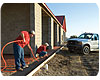
Ohio contractor John Long's crew installs some of the 4,200 lineal feet
of PEX to keep the car wash warm and dry. Photo: John Evans
“Rather than maintaining high mass, standby energy at considerable cost, the two-stage boiler meets the need easily,” Long explains. “It quickly injects incremental energy into the system loops, or to the heat exchanger on demand - a real benefit for an installation like this one.”
To handle the thermostatic mixing, controls and fluid flow to both systems, Long built a control panel, which he hung near the boiler.
“We put the boiler, control panel, heat exchanger and storage tank in a small mechanical room located at the center of the car wash facility,” Long adds. “Space was tight, so the boiler’s small footprint was a perfect fit for our needs.”
A sophisticated microprocessor control monitors outdoor temperature and, at 36 degrees Fahrenheit, the snowmelt system is activated. The outdoor-reset system then sets system temperatures. For the most part, the hydronic system is set to idle throughout the winter months, with programmed instructions to keep slab surface temperatures at a steady 35 degrees.
“It works beautifully,” says D.J. Jones, one of the car wash owners, “even during and after heavy snowfalls.” Jones is well-known in the area, having helped Ohio State University win the Rose Bowl in 1997. He played one year for the Pittsburgh Steelers, but was forced out of his football career with a neck injury.
“Most of the systems that we looked at used two boilers for a car wash application like ours,” Jones adds. “But the boiler, controls and system operation Long installed was a better solution. It was less expensive, and the boiler’s high efficiency gave us good use of our energy dollar, too.”
Of the boiler’s 750 mbh capacity, it was calculated that a maximum of 300,000 Btus would be required for all commercial wash water needs with all bays loaded. The remaining capacity serves the snowmelt system’s needs.
Links
Looking for a reprint of this article?
From high-res PDFs to custom plaques, order your copy today!