Ferguson's Fab Shop
Where Craftsmen Go To Work
This distributor is raising the bar on service
to an expanding radiant community.
The Rockies are a stronghold of hydronic and especially radiant heat, owing to a climate in which people tend to turn on their a/c only about a dozen days a year, if they even have it. The state is also one of the greenest around and environmental consciousness plays right into the marketing strengths of energy-efficient radiant heat.
This is the market of Ferguson Hydronics, operating out of the company’s Denver branch and serving contractors throughout the state. Since Hydronics Manager Dennis Bellanti took over six years ago, the business unit has grown from a one-man operation to 12 full-time sales and technical support personnel. According to Bellanti, when it comes to radiant, sales and technical support are basically one and the same. Ferguson is one of many distributors in the area that have capitalized on the growing interest in radiant heat. So, says Bellanti, in order to keep growing sales, it has to keep “raising the bar” on service to an expanding radiant community that now includes about 400 contractors statewide who patronize Ferguson Hydronics.
The distributor offers a wide array of support services spanning design, quotations, training, troubleshooting, marketing, business education and more. So do many competitors, often following Ferguson’s lead. Thus, the bar keeps going higher. Last year, the company pushed it to a rarefied level by opening a fabrication shop for customers.
“We expected the prepiped assemblies to sell more than they have,” notes Greg Burney, a licensed master plumber turned tech support specialist and Bellanti’s right arm at Ferguson Hydronics. “I think contractors shy away from them because of pride in workmanship. They’re mechanical guys and putting all that stuff together is their favorite part of a job - I know it was always mine. That’s one reason why the panels haven’t taken off, plus cost. Basically, they’re paying for someone else’s labor. You can cost-justify that all day long, but they don’t think that way.”
This DIY instinct runs into some harsh realities on jobsites. Mechanical rooms and basements are usually cramped and, by definition, heating techs do their thing in places that mostly lack heat. And it gets plenty cold in the Colorado mountains. Set-up means hauling tools, equipment and materials in and out of the confined spaces, often trudging through snow and ice and maybe up and down stairways. No matter how much a craftsman relishes the hands-on work, nobody in his right mind would enjoy the mule part of a job.
Meantime, Ferguson’s Denver warehouse had an old storage room filled with what politely could be called assorted parts, or less genteelly, junk. Bellanti and his crew came up with a brainstorm to turn it into something more useful.
They cleared out the storage room and created a fabrication facility where contractors could put assemblies together in comfort. It’s clean and well-lit, with exhaust fans to vent away fumes from soldering and brazing. If the craftsman overlooks a part or runs short of fittings, he’s just steps from an amply stocked warehouse rather than miles away. The fab shop is equipped with state-of-art tools and equipment so that users don’t have to haul all the heavy-duty items in and out of jobsites. These include a copper-fitter, chop saw, acetylene torch rig, grinder, chain vice, wrenches, work benches and backing boards. All of it is free to users, except for the job materials that they naturally purchase from Ferguson.
About the only thing this shop lacks is a catchy name. Bellanti and crew were too absorbed setting it up to think of anything except the descriptive but cumbersome “You-Build-It-Here Ferguson Customer Fab Shop.” So from here on I’ll borrow the name given by Dan Holohan in his December 2007 PM article ("Where Babies Come From") about the facility: “The Nursery” - a place where radiant systems get born.

“Many of the people that used it a lot in the beginning have not been using it lately,” Bellanti says. “I called them to see why, and almost every one said they liked it so much they built one of their own.”
That’s fine with him, because one result has been the sale of a bunch of the same tools and equipment used in The Nursery. “We carry a Ridgid copper-cutting machine that sells for around $1,500,” Bellanti adds. “Before the fab shop came along we sold very few of them because most of our customers didn’t want to spend that kind of money. But we put one in the fab shop and once they started using it, they realized its value. Ever since they’ve been buying them like crazy to use either in the field or in their own fab shops.”
Even though The Nursery was never conceived as a profit center, it likely has paid for itself and then some in various ways. In addition to boosting sales of big-ticket copper-cutters, Ferguson is getting sales they may not have gotten on copper tubing and various other materials. That’s because when contractors are heading out to a jobsite, they’ll often stop to pick up materials at whatever supply house happens to be on the way. Now Ferguson gets those sales. Impulse buying also comes into play as customers pass through a bulging warehouse and counter area on their way to the shop.
Plenty of intangible benefits also accrue. For instance, Ferguson’s tech support people frequently get called on to troubleshoot in the field. It saves a lot of time and trouble when the journey involves a few footsteps instead of a drive across town or to a distant town. Same with training. Ferguson Hydronics personnel spend a lot of time doing hands-on teaching of inexperienced technicians. Novices now come to them for over-the-shoulder supervision, and with assurance everything that’s needed for the job will be close at hand.
Bellanti sees the slowdown in usage as an opportunity more than anything else. “Even though a lot of former users have built their own shops, we’re seeing a lot of new faces in here. We may end up cycling generation after generation of contractors through here, and that would be great for us.”
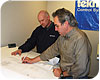
Ferguson’s Dennis Bellanti (foreground) and Greg
Burney go over a radiant design.
The Rockies are a stronghold of hydronic and especially radiant heat, owing to a climate in which people tend to turn on their a/c only about a dozen days a year, if they even have it. The state is also one of the greenest around and environmental consciousness plays right into the marketing strengths of energy-efficient radiant heat.
This is the market of Ferguson Hydronics, operating out of the company’s Denver branch and serving contractors throughout the state. Since Hydronics Manager Dennis Bellanti took over six years ago, the business unit has grown from a one-man operation to 12 full-time sales and technical support personnel. According to Bellanti, when it comes to radiant, sales and technical support are basically one and the same. Ferguson is one of many distributors in the area that have capitalized on the growing interest in radiant heat. So, says Bellanti, in order to keep growing sales, it has to keep “raising the bar” on service to an expanding radiant community that now includes about 400 contractors statewide who patronize Ferguson Hydronics.
The distributor offers a wide array of support services spanning design, quotations, training, troubleshooting, marketing, business education and more. So do many competitors, often following Ferguson’s lead. Thus, the bar keeps going higher. Last year, the company pushed it to a rarefied level by opening a fabrication shop for customers.
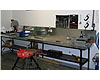
One of the fab shop’s work benches. The use of the
fab shop and its tools are free; users need only pay for any materials they
use.
Ferguson's Fabulous Fab Shop
The heart of a radiant system consists of the piping, valves, controls and circulators that regulate the temperature and flow of water out of the boiler through manifolds and tubing into various zones. Contractors and their technicians typically mount these assemblies on plywood boards or some other suitable backing material. It’s a labor-intensive task, and many hydronics manufacturers are marketing pre-assembled packaged systems to make life easier for technicians.“We expected the prepiped assemblies to sell more than they have,” notes Greg Burney, a licensed master plumber turned tech support specialist and Bellanti’s right arm at Ferguson Hydronics. “I think contractors shy away from them because of pride in workmanship. They’re mechanical guys and putting all that stuff together is their favorite part of a job - I know it was always mine. That’s one reason why the panels haven’t taken off, plus cost. Basically, they’re paying for someone else’s labor. You can cost-justify that all day long, but they don’t think that way.”
This DIY instinct runs into some harsh realities on jobsites. Mechanical rooms and basements are usually cramped and, by definition, heating techs do their thing in places that mostly lack heat. And it gets plenty cold in the Colorado mountains. Set-up means hauling tools, equipment and materials in and out of the confined spaces, often trudging through snow and ice and maybe up and down stairways. No matter how much a craftsman relishes the hands-on work, nobody in his right mind would enjoy the mule part of a job.
Meantime, Ferguson’s Denver warehouse had an old storage room filled with what politely could be called assorted parts, or less genteelly, junk. Bellanti and his crew came up with a brainstorm to turn it into something more useful.
They cleared out the storage room and created a fabrication facility where contractors could put assemblies together in comfort. It’s clean and well-lit, with exhaust fans to vent away fumes from soldering and brazing. If the craftsman overlooks a part or runs short of fittings, he’s just steps from an amply stocked warehouse rather than miles away. The fab shop is equipped with state-of-art tools and equipment so that users don’t have to haul all the heavy-duty items in and out of jobsites. These include a copper-fitter, chop saw, acetylene torch rig, grinder, chain vice, wrenches, work benches and backing boards. All of it is free to users, except for the job materials that they naturally purchase from Ferguson.
About the only thing this shop lacks is a catchy name. Bellanti and crew were too absorbed setting it up to think of anything except the descriptive but cumbersome “You-Build-It-Here Ferguson Customer Fab Shop.” So from here on I’ll borrow the name given by Dan Holohan in his December 2007 PM article ("Where Babies Come From") about the facility: “The Nursery” - a place where radiant systems get born.
The Ferguson Hydronics team
New Generations
The birthing analogy has taken on a new twist since Dan’s article was published. When he wrote it, The Nursery was bustling with business. Contractors had to call in to reserve times and some days had all time slots occupied. In the half-year or so between Dan’s visit and mine, bookings had slowed down considerably.“Many of the people that used it a lot in the beginning have not been using it lately,” Bellanti says. “I called them to see why, and almost every one said they liked it so much they built one of their own.”
That’s fine with him, because one result has been the sale of a bunch of the same tools and equipment used in The Nursery. “We carry a Ridgid copper-cutting machine that sells for around $1,500,” Bellanti adds. “Before the fab shop came along we sold very few of them because most of our customers didn’t want to spend that kind of money. But we put one in the fab shop and once they started using it, they realized its value. Ever since they’ve been buying them like crazy to use either in the field or in their own fab shops.”
Even though The Nursery was never conceived as a profit center, it likely has paid for itself and then some in various ways. In addition to boosting sales of big-ticket copper-cutters, Ferguson is getting sales they may not have gotten on copper tubing and various other materials. That’s because when contractors are heading out to a jobsite, they’ll often stop to pick up materials at whatever supply house happens to be on the way. Now Ferguson gets those sales. Impulse buying also comes into play as customers pass through a bulging warehouse and counter area on their way to the shop.
Plenty of intangible benefits also accrue. For instance, Ferguson’s tech support people frequently get called on to troubleshoot in the field. It saves a lot of time and trouble when the journey involves a few footsteps instead of a drive across town or to a distant town. Same with training. Ferguson Hydronics personnel spend a lot of time doing hands-on teaching of inexperienced technicians. Novices now come to them for over-the-shoulder supervision, and with assurance everything that’s needed for the job will be close at hand.
Bellanti sees the slowdown in usage as an opportunity more than anything else. “Even though a lot of former users have built their own shops, we’re seeing a lot of new faces in here. We may end up cycling generation after generation of contractors through here, and that would be great for us.”
Looking for a reprint of this article?
From high-res PDFs to custom plaques, order your copy today!