
2007 Solar Decathlon To Promote Solar-based Heating, Hot Water Systems
Twenty teams
have been selected from colleges and universities around the globe to compete
in the 2007 Solar Decathlon taking place Oct. 12-20 in Washington, D.C., by
designing, building and operating the most attractive and energy-efficient
solar-powered home.

The U.S. Department of Energy’s 2007 Solar Decathlon will take place on the National Mall in Washington, D.C., Oct. 12-20. Twenty teams have been selected from colleges and universities around the globe to compete in the solar-based event by designing, building and operating the most attractive and energy-efficient solar-powered home. The teams selected for the competition will be awarded $100,000 over two years to support the Solar Decathlon’s research goal of reducing the cost of solar-powered homes and advancing solar technology.
In fall 2007, the teams will transport their 700-square-foot solar houses to the National Mall, where they will form a solar village. The teams then compete in 10 contests to determine an overall winner. Using only energy from the sun, the teams generate enough electricity to run a modern household.
The 2005 competition featured a number of new and customized energy-producing and energy-efficient technologies. They included new kinds of structural insulated wall panels (SIPs), a customized “solar chimney,” a fuel cell energized by solar-produced hydrogen, and an energy recovery ventilator.
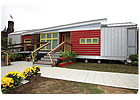 The University of Colorado’s 2005 entry was
chosen Overall Competition Winner and featured a unique “take” on the
traditional SIP. For the walls, the team combined two off-the-shelf green building
components into one newly patented SIP. The Colorado team’s “BioSIP” was like a
giant ice cream sandwich made of two panels of Sonoboard - a strong but
lightweight board made of recycled materials by Sonoco Co. - that are filled
with BioBase 501, a lightweight foam insulation made from soybean oil by
BioBased Systems.
The University of Colorado’s 2005 entry was
chosen Overall Competition Winner and featured a unique “take” on the
traditional SIP. For the walls, the team combined two off-the-shelf green building
components into one newly patented SIP. The Colorado team’s “BioSIP” was like a
giant ice cream sandwich made of two panels of Sonoboard - a strong but
lightweight board made of recycled materials by Sonoco Co. - that are filled
with BioBase 501, a lightweight foam insulation made from soybean oil by
BioBased Systems.
The solar chimney concept was based on the simple principle that warm air, being less dense than cooler air, rises. The University of Michigan team decided to adapt a much smaller version to provide passive solar heating and cooling to its Solar Decathlon home. In this solar chimney, sunlight heated the air in glass spaces at the base of the home’s south wall. The heated air would then rise along the curve of the roof and be either directed into the house by means of specially placed louvers for heating in winter, or released outside to cool the home in summer. The layer of air in the chimney provided convective and radiant heating control and added insulation.
The team from the New York Institute of Technology also customized solar and renewable energy technologies for its 2005 competition home. The team used some of the electricity generated by its roof-mounted photovoltaic system to separate the hydrogen and oxygen in water through a process known as “electrolysis.” The hydrogen was then stored and used later to power a fuel cell that produces electricity and heat on demand.
 Cornell University’s team customized an energy
recovery ventilator (ERV) to provide heating and cooling to its 2005
competition home. The ERV housed a silica gel wheel, also known as a desiccant
dehumidifier, which transferred heat and humidity between the home’s intake and
exhaust airstreams. The Cornell team’s ERV was coupled with an electric heat
pump and an air handler. A fully automatic computerized control system was able
to operate the ERV, as well as the rest of the heating and cooling system.
Cornell University’s team customized an energy
recovery ventilator (ERV) to provide heating and cooling to its 2005
competition home. The ERV housed a silica gel wheel, also known as a desiccant
dehumidifier, which transferred heat and humidity between the home’s intake and
exhaust airstreams. The Cornell team’s ERV was coupled with an electric heat
pump and an air handler. A fully automatic computerized control system was able
to operate the ERV, as well as the rest of the heating and cooling system.
The Solar Decathlon is a competition sponsored by the U.S. Department of Energy’s Office of Energy Efficiency and Renewable Energy in partnership with its National Renewable Energy Laboratory. The American Institute of Architects; American Society of Heating, Refrigerating and Air-Conditioning Engineers; the National Association of Home Builders; BP; and Sprint are partnering with DOE as title sponsors.
For more information on the 2007 event, visit the Web site www.eere.energy.gov/solar_decathlon/.
Nearly 25,000 people visited the Solar Decathlon
on the National Mall in Washington, D.C., Oct. 9, 2005. Photo by Steven A.
Novy, AIA, Green Line Architects.
The U.S. Department of Energy’s 2007 Solar Decathlon will take place on the National Mall in Washington, D.C., Oct. 12-20. Twenty teams have been selected from colleges and universities around the globe to compete in the solar-based event by designing, building and operating the most attractive and energy-efficient solar-powered home. The teams selected for the competition will be awarded $100,000 over two years to support the Solar Decathlon’s research goal of reducing the cost of solar-powered homes and advancing solar technology.
In fall 2007, the teams will transport their 700-square-foot solar houses to the National Mall, where they will form a solar village. The teams then compete in 10 contests to determine an overall winner. Using only energy from the sun, the teams generate enough electricity to run a modern household.
The 2005 competition featured a number of new and customized energy-producing and energy-efficient technologies. They included new kinds of structural insulated wall panels (SIPs), a customized “solar chimney,” a fuel cell energized by solar-produced hydrogen, and an energy recovery ventilator.
The University of Colorado’s award-winning solar
home from the 2005 Solar Decathlon. Photo by Stefano Paltera/Solar Decathlon.
The solar chimney concept was based on the simple principle that warm air, being less dense than cooler air, rises. The University of Michigan team decided to adapt a much smaller version to provide passive solar heating and cooling to its Solar Decathlon home. In this solar chimney, sunlight heated the air in glass spaces at the base of the home’s south wall. The heated air would then rise along the curve of the roof and be either directed into the house by means of specially placed louvers for heating in winter, or released outside to cool the home in summer. The layer of air in the chimney provided convective and radiant heating control and added insulation.
The team from the New York Institute of Technology also customized solar and renewable energy technologies for its 2005 competition home. The team used some of the electricity generated by its roof-mounted photovoltaic system to separate the hydrogen and oxygen in water through a process known as “electrolysis.” The hydrogen was then stored and used later to power a fuel cell that produces electricity and heat on demand.
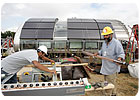
University of Michigan student Gabe Keway (left)
and faculty advisor Moji Navvab (right) work on a solar thermal collector for
their solar home in the 2005 Solar Decathlon. Photo by Stefano Paltera/Solar
Decathlon.
The Solar Decathlon is a competition sponsored by the U.S. Department of Energy’s Office of Energy Efficiency and Renewable Energy in partnership with its National Renewable Energy Laboratory. The American Institute of Architects; American Society of Heating, Refrigerating and Air-Conditioning Engineers; the National Association of Home Builders; BP; and Sprint are partnering with DOE as title sponsors.
For more information on the 2007 event, visit the Web site www.eere.energy.gov/solar_decathlon/.
Looking for a reprint of this article?
From high-res PDFs to custom plaques, order your copy today!