
Professional Pace
New York plumbing contractor’s sophisticated operation keeps it on top of a changing market.

When you do most of your plumbing jobs in New York City high-rises, keeping your ear to the ground can be challenging. Over the years, however, Brooklyn-based Pace Plumbing has shown a talent for anticipating market changes and taking advantage of new opportunities. In the last three years, Pace has made a dramatic shift in its workload from high-rises to government-financed projects.
“We do what the market demands of us,” says Harold Block, CEO of Pace Plumbing, which he founded in 1968. “There’s publicly funded work now. So, we’ve adjusted our focus in an effort to pursue that business much more vigorously than ever before.”
Block estimates 60 percent of his company’s $50 million in annual revenue comes from publicly financed projects. Another 25 percent is derived from residential work and 15 percent from private commercial jobs.
The city’s high-rises dominated the company’s workload from 2003 to 2009, notes Pace President Andru Coren. By 2007, though, articles in business publications, conversations with customers and his gut feeling were telling him it was time to shift directions.
Coming online were public jobs, which since have increased with an injection of federal stimulus money and government-mandated green buildings. Signature New York City projects for Pace include the Jacob Javits Convention Center, the United Nations Secretariat Building, the Thurgood Marshall Federal Courthouse and the World Trade Center site.
“Each government entity has unique security requirements, and contractors need to be prequalified for these jobs,” Coren says. “In 2006, we did none of this work. Today, it’s a big focus of our business.”

Today, Pace Plumbing employs about 150 union plumbers and sprinkler fitters in the field. Staff at its modern headquarters consists of 35 people in its second-floor offices and first-floor prefabrication shop.
Along with its new construction work, the company maintains a fleet of 10 service trucks manned by 20 service plumbers under the direction of Ziggy Moscicki. Pace Fire Protection Director of Operations Mike Egan says 60 percent of his work comes from renovation and sprinkler retrofits with the remaining 40 percent new construction.
“We never say a job is too little,” Account Executive Adam Levy says. “We don’t say, ‘No,’ no matter what the value is. We’ll do a $500 job or a $50,000 job, and that’s helped us ride this recession out.”
Keeping up with a changing market has demanded more than luck, foresight and smart marketing. Pace has built its success on a solid foundation of innovative business practices.
“Our company is a family business, which we’re proud of, but we don’t want it to be a liability,” says Coren, who is Block’s son-in-law. Levy, who is Block’s grandson and Coren’s nephew, represents the family’s third generation. “We see it as a combination of a family business and very professional operation.”
Its detailed cost-tracking system, interactive Web site and eight-person engineering department best exemplify Pace Plumbing’s professionalism. They have helped to differentiate the company from its competitors during a difficult economy.

“We’re here to make money,” Coren says. “A foreman in Manhattan overseeing a big crew and millions of dollars worth of work has to be a step above intellectually. We treat him like that. We recognize that he is more than an average plumber.”
That being said, the Internet connection allows him, Block, Levy and Director of Operations Joe Piscitello to micromanage a job from the office when necessary and, Coren adds, occasionally “drive supervisors crazy.”
“A job ‘going down the tubes’ doesn’t have to go down the tubes; you can refocus and change direction if you catch a problem early,” Coren says. “Even with a great job, you sometimes still have to change focus. You can take a double and make it a home run.”
Too many plumbing contractors say that they’ll keep their fingers crossed about making money on a job or won’t know their labor costs until they finish a project, he notes. With its customized software program, Pace can track job costs floor by floor and task by task.
“We can see where we are now, what our costs are at the end of the day and extrapolate from that about what our costs will be for the remainder of the work,” Coren says. “Since we can see where a job is going, nothing ever shocks me.”
The new site allows both Pace staff and customers to view an ongoing project’s progress in several areas: accounting, permit status, submittals, e-mail correspondence, progress photos, change-order history and requests for information.
“The new site is more user-friendly for customers and Pace Plumbing,” Levy says. “We’re trying to make it less work for our customers to do business with us. At the same time, the new site can be an even bigger tool for our staff.
“It helps with our internal organization. At the end of each project, we have a comprehensive job folder that contains costs, permits, e-mail records and photos.”
Pace posts updated job information that is no older than the previous day’s. The company is leading its customers toward paperless communication, although general contractors usually still want paper documents, Coren says.
“Our new Web site is a major time-saving tool for our customers and a selling point for Pace Plumbing to GCs,” he adds. “The upper-echelon guys love it. The biggest problem we have is their people in the field don’t use it as much as they could. We’re trying to change the culture of GCs in the field.”
Exceptional Engineering: To help capture and then design high-rise projects, Pace Plumbing added an engineering department 12 years ago. Today, under Vice President/Director of Engineering Rich Bailey, the department helps to set Pace apart from other plumbing contractors.
By bringing the engineering in-house, Pace patterned itself after HVAC contractors, Coren says. The company invested in CAD programs and, more recently, in building information modeling software. Pace’s engineers have utilized BIM to help the contractor reduce its job costs and increase its profitability, he adds.
“Everybody will use BIM in a few years; right now we have it,” Coren says. “There’s a cost associated with BIM, so people are backing off. Everyone will go back to BIM when the economy gets better.”
The scale of projects in big-city markets such as New York requires the level of business sophistication that Pace exhibits, Coren says. The World Trade Center site illustrates his point.
Pace bid one of the buildings to be erected on the site in 2007 and was awarded the contract in mid-2008. Now, two years later, Pace hasn’t installed one piece of pipe. In fact, developers recently moved the building’s completion date to 2014 from the original date of 2012.
“How do you bid a job in 2007 that’s completed in 2014?” Coren asks. “How do you do business in that environment?”
For Pace, the answers came in using its software to calculate labor costs and the pre-purchasing of all of the fixtures and equipment; they took delivery and put the products into storage, where they could stay for four years. By that time, the market likely will change again.
“It will be four or five years before we see residential demand,” Block says. “Many of the publicly funded projects we’re doing today will last three or four years, so that will allow us to ride this trend.”
When the time comes to shift directions again, he adds, Pace Plumbing’s business systems and its people will allow the company to make a smooth transition.
Harold Block, Adam Levy and Andru Coren review documents in Pace's conferenceroom. PM pages from a previous feature story are mounted on the wall.
When you do most of your plumbing jobs in New York City high-rises, keeping your ear to the ground can be challenging. Over the years, however, Brooklyn-based Pace Plumbing has shown a talent for anticipating market changes and taking advantage of new opportunities. In the last three years, Pace has made a dramatic shift in its workload from high-rises to government-financed projects.
“We do what the market demands of us,” says Harold Block, CEO of Pace Plumbing, which he founded in 1968. “There’s publicly funded work now. So, we’ve adjusted our focus in an effort to pursue that business much more vigorously than ever before.”
Block estimates 60 percent of his company’s $50 million in annual revenue comes from publicly financed projects. Another 25 percent is derived from residential work and 15 percent from private commercial jobs.
The city’s high-rises dominated the company’s workload from 2003 to 2009, notes Pace President Andru Coren. By 2007, though, articles in business publications, conversations with customers and his gut feeling were telling him it was time to shift directions.
Coming online were public jobs, which since have increased with an injection of federal stimulus money and government-mandated green buildings. Signature New York City projects for Pace include the Jacob Javits Convention Center, the United Nations Secretariat Building, the Thurgood Marshall Federal Courthouse and the World Trade Center site.
“Each government entity has unique security requirements, and contractors need to be prequalified for these jobs,” Coren says. “In 2006, we did none of this work. Today, it’s a big focus of our business.”
Pace Plumbing executives (from left) CEO Harold Block, Account
Executive Adam Levy and President Andru Coren (right) visit the World
Trade Center site and Foreman Al Lettera in early March.
Two Paces Ahead
Longtime PM readers may recognize Pace Plumbing, which has been featured on our cover and in our pages twice previously. In December 1985, PM’s cover photo depicted Block at the Statue of Liberty, whose plumbing needed a serious update at the time. In our October 1995 cover story, Block and Coren discussed New York’s toilet rebate program and how their marketing acumen gave them a competitive edge in installing thousands of low-flow fixtures.Today, Pace Plumbing employs about 150 union plumbers and sprinkler fitters in the field. Staff at its modern headquarters consists of 35 people in its second-floor offices and first-floor prefabrication shop.
Along with its new construction work, the company maintains a fleet of 10 service trucks manned by 20 service plumbers under the direction of Ziggy Moscicki. Pace Fire Protection Director of Operations Mike Egan says 60 percent of his work comes from renovation and sprinkler retrofits with the remaining 40 percent new construction.
“We never say a job is too little,” Account Executive Adam Levy says. “We don’t say, ‘No,’ no matter what the value is. We’ll do a $500 job or a $50,000 job, and that’s helped us ride this recession out.”
Keeping up with a changing market has demanded more than luck, foresight and smart marketing. Pace has built its success on a solid foundation of innovative business practices.
“Our company is a family business, which we’re proud of, but we don’t want it to be a liability,” says Coren, who is Block’s son-in-law. Levy, who is Block’s grandson and Coren’s nephew, represents the family’s third generation. “We see it as a combination of a family business and very professional operation.”
Its detailed cost-tracking system, interactive Web site and eight-person engineering department best exemplify Pace Plumbing’s professionalism. They have helped to differentiate the company from its competitors during a difficult economy.
Pace's engineering department (from left) includes: David Pio, Robert Pena, Vice President/Director of Engineering Rich Bailey, Don Waller and George Dimaano.
Accounting and Accountability
Pace’s job-cost accounting system requires all its project foremen to fill out reports every morning and to keep a foreman’s book on each job. Every foreman in the field carries a laptop, which is connected to the Internet via a wireless connection or air card.“We’re here to make money,” Coren says. “A foreman in Manhattan overseeing a big crew and millions of dollars worth of work has to be a step above intellectually. We treat him like that. We recognize that he is more than an average plumber.”
That being said, the Internet connection allows him, Block, Levy and Director of Operations Joe Piscitello to micromanage a job from the office when necessary and, Coren adds, occasionally “drive supervisors crazy.”
“A job ‘going down the tubes’ doesn’t have to go down the tubes; you can refocus and change direction if you catch a problem early,” Coren says. “Even with a great job, you sometimes still have to change focus. You can take a double and make it a home run.”
Too many plumbing contractors say that they’ll keep their fingers crossed about making money on a job or won’t know their labor costs until they finish a project, he notes. With its customized software program, Pace can track job costs floor by floor and task by task.
“We can see where we are now, what our costs are at the end of the day and extrapolate from that about what our costs will be for the remainder of the work,” Coren says. “Since we can see where a job is going, nothing ever shocks me.”
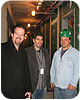
Pace Fire Protection Director of Operations Mike Egan (left) with
Project Manager Adam Foresta and General Foreman John Italiano stand in
a hallway of the Gansevoort Hotel, under construction in Manhattan.
Interactive Web Site
Tied closely to Pace’s ability to track job costs is www.paceplumbing.com. The company has maintained a Web site for customers for a dozen years and launched the latest version within the last few months.The new site allows both Pace staff and customers to view an ongoing project’s progress in several areas: accounting, permit status, submittals, e-mail correspondence, progress photos, change-order history and requests for information.
“The new site is more user-friendly for customers and Pace Plumbing,” Levy says. “We’re trying to make it less work for our customers to do business with us. At the same time, the new site can be an even bigger tool for our staff.
“It helps with our internal organization. At the end of each project, we have a comprehensive job folder that contains costs, permits, e-mail records and photos.”
Pace posts updated job information that is no older than the previous day’s. The company is leading its customers toward paperless communication, although general contractors usually still want paper documents, Coren says.
“Our new Web site is a major time-saving tool for our customers and a selling point for Pace Plumbing to GCs,” he adds. “The upper-echelon guys love it. The biggest problem we have is their people in the field don’t use it as much as they could. We’re trying to change the culture of GCs in the field.”
Exceptional Engineering: To help capture and then design high-rise projects, Pace Plumbing added an engineering department 12 years ago. Today, under Vice President/Director of Engineering Rich Bailey, the department helps to set Pace apart from other plumbing contractors.
By bringing the engineering in-house, Pace patterned itself after HVAC contractors, Coren says. The company invested in CAD programs and, more recently, in building information modeling software. Pace’s engineers have utilized BIM to help the contractor reduce its job costs and increase its profitability, he adds.
“Everybody will use BIM in a few years; right now we have it,” Coren says. “There’s a cost associated with BIM, so people are backing off. Everyone will go back to BIM when the economy gets better.”
The scale of projects in big-city markets such as New York requires the level of business sophistication that Pace exhibits, Coren says. The World Trade Center site illustrates his point.
Pace bid one of the buildings to be erected on the site in 2007 and was awarded the contract in mid-2008. Now, two years later, Pace hasn’t installed one piece of pipe. In fact, developers recently moved the building’s completion date to 2014 from the original date of 2012.
“How do you bid a job in 2007 that’s completed in 2014?” Coren asks. “How do you do business in that environment?”
For Pace, the answers came in using its software to calculate labor costs and the pre-purchasing of all of the fixtures and equipment; they took delivery and put the products into storage, where they could stay for four years. By that time, the market likely will change again.
“It will be four or five years before we see residential demand,” Block says. “Many of the publicly funded projects we’re doing today will last three or four years, so that will allow us to ride this trend.”
When the time comes to shift directions again, he adds, Pace Plumbing’s business systems and its people will allow the company to make a smooth transition.
Links
Looking for a reprint of this article?
From high-res PDFs to custom plaques, order your copy today!