Practical Green
A new expansion becomes a showcase for J.F. Ahern Co.'s LEED construction skills and design expertise.

J.F. Ahern Co. had the perfect opportunity to showcase the company’s green building know-how when executives decided to add on to its Fond du Lac, Wis., headquarters - build the 58,000-square-foot expansion with Leadership in Energy and Environmental Design or LEED Gold status in mind.
“The trend toward sustainability is obvious,” says John E. “Tripp” Ahern III, president and CEO of the full-service mechanical contractor that lands in position No. 19 in this year’s Pipe Trade Giants ranking, “and as a mechanical contractor we have a unique position to make a real impact. Our mechanical systems are at the hub of the energy and water consumption of any facility.”
In fact, 42 out of 69 possible LEED points for new construction are directly related to mechanical systems or mechanical construction. (See the sidebar on “LEED 2009” for some changes to the point system coming next year.) What Ahern’s design and engineering crew came up with for themselves is quite literally a green showroom for what the company can offer its clients.
“It used to be quite difficult to get our clients to come here,” says Robert J. Fischer, P.E., executive vice president of commercial contracting, meaning that Fond du Lac isn’t exactly conveniently located to many of the company’s branch offices, even those in Wisconsin and Illinois.
 But thanks to the new
expansion, Fischer says clients are coming to take a look around most every
week and many local contracting and engineering trade association regularly
hold meetings at the site.
But thanks to the new
expansion, Fischer says clients are coming to take a look around most every
week and many local contracting and engineering trade association regularly
hold meetings at the site.
Much of the work was done with sightseeing in mind. Visitors can easily look into windows highlighting the mechanical systems or look down into cutaways of the radiant floor. Candy-colored piping offers visual cues to the work, too. And along the hallways, various signs explain the details. If that isn’t enough, the new building’s conference rooms are named after the six recognized LEED building categories.
In its first full year of operations, a company brochure offers the following “efficiency scorecard” on the expansion:
“There are some LEED points that don’t carry with them quite the same cost-benefit that the energy-related LEED points do,” Ahern adds. When the company executives planned the expansion, Ahern says a return on investment analysis - the exact same analysis they would offer clients - pointed toward which LEED points to pursue.
“If you start to think a little more long-term,” Ahern explains, “and you also start to couple the financial responsibility of your organization along with a sense of environmental stewardship that business leaders need today, then you can make a very compelling value proposition as to why you should build green.”
Since our focus is on plumbing, piping and heating, let’s take a look at what the company incorporated for those areas in the expansion. (See sidebar on “LEED Features” for a complete list of the expansion’s green construction systems and building techniques.)
We read before our office visit how the system uses rainwater to flush toilets and urinals, but we were a little surprised at its modest size when Craig W. Bahr, P.E., project manager, water/wastewater department, took us for a tour.
Of course, what we couldn’t see was the 20,000-gallon underground concrete cistern that collects rainfall from the roof before its treated and pumped into a 1,500-gallon storage tank on display.
Basically, what you can see represents two days’ worth of water for flushing fixtures in the new building’s bathrooms. Bahr explained that the rainwater goes through two different stages of filtration before finally being treated with ultraviolet light. While all that sounds like overkill for water destined to flush a toilet, Bahr says the treatment is still required by the state.
The greenwater system, along with, of course, the requisite low-flush toilets and urinals and low-flow faucets, saves the company 750 gallons of water every working day.
Although the greenwater system helps cut water and sewage bills, Bahr says one of the biggest advantages of the system was what the company didn’t have to spend money on. With it, Ahern didn’t have to run a water line to the expansion. Bahr says the system will pay for itself in 10 years.
 A much shorter payback can be found in another
mechanical system designed to cut cooling costs. An ice storage system operates
at night, making ice - Bahr prefers to call it “slush” - when electricity rates
drop to 3-4 cents per kilowatt, half of what they are during the
day.
A much shorter payback can be found in another
mechanical system designed to cut cooling costs. An ice storage system operates
at night, making ice - Bahr prefers to call it “slush” - when electricity rates
drop to 3-4 cents per kilowatt, half of what they are during the
day.
The system works in tandem with a more traditional chiller system during peak daytime cooling hours. The ice system contributes about 40 tons of the needed 110 tons of cooling at peak demand. Bahr puts the payback at 3 1/2 years.
As for heating, radiant tubing runs along the perimeter of the building, an ideal place to augment heat in staff offices. Bahr can’t put a payback on the radiant system, but adds that the underfloor heat certainly helps lower overall heating bills without, more importantly, sacrificing everyone’s comfort during Wisconsin winters.
Talking with other Ahern executives during our visit underscored some of the peculiarities that we hear from plumbing contractors about the LEED point system. For example, we always hear the lament that you get a point for a bike rack, but nothing for an elaborate water reclamation system.
“Having special carpool parking spaces and a bike rack doesn’t mean people will carpool or ride their bikes to work,” adds Fischer. But everyone is going to flush a toilet during the day and expect to warm and cool throughout the year.
LEED officials typically counter the bike rack complaint by pointing out that all the points certainly do add up and that the system needs to be viewed from a step back in order to take in the integrated, whole building philosophy behind green building. Besides, plumbers might be interested in some of the changes LEED has promised starting next year for its water efficiency category.
The company is currently going through the process of securing LEED Gold status for the expansion. In the meantime, Ahern mentioned one LEED attribute that has much more to do with building a workforce than construction projects.
“Young people just graduating from either college or high school have grown up with the issue of green building,” he adds, “and I think it’s very important to promote our green building knowledge in order to attract people to our company. You want to be known as a good place to work and having a LEED-certified facility establishes that fact.”
We’ll second that opinion since it’s exactly how we ended up learning about this story. Last summer, we worked on a profile of a student chapter member of the Mechanical Contractors Association of America. At the time, he was hoping to be a finalist on the MCAA’s annual student chapter competition in which collegians work on a building proposal. This year’s project held at MCAA’s convention last March was based on Ahern’s green expansion.
Sustainable Site Development
White roof: The building’s white roof helps
reflect heat and reduce cooling demands.
Exterior lighting:
Only two small fixtures light the outside of the building and lights in the parking
lot operate on sensors.
Alternative transportation:
Carpool to work and you may have a prime parking spot waiting for you closer to
the building. Bike racks, storage and shower facilities also help encourage employees
to get to work by means other than a car.
Water Efficiency
Greenwater reclamation system: Underground storage tanks collect storm water runoff. The
water is to flush toilets and urinals located throughout the expansion.
Bathroom fixtures:
You’d expect sensor-operated faucets, but dual-flush stem valves flush toilets
in the women’s restrooms, too.
Energy And Atmosphere
Ice storage: A system makes ice at night
when electrical rates are that much lower. The ice is used along with the
chiller during peak daytime cooling hours.
Commissioning:
Ahern’s experienced commissioning team performs startup, balancing and
functional testing of all the building mechanical systems.
Radiant heating:
Offices along the perimeter get supplemental heat from an underfloor
system.
Natural
lighting: The atrium
between the old and the new buildings serves as a gathering point for
employees. The three-story atrium features plenty of sunlight, which is
augmented by sensors that control traditional light fixtures.
Materials And Resources
Recyclable material
collections: Employees
don’t have to walk far to find handy receptacles for recyclable materials.
Recycled building
materials: The company used drywall made of 10 percent
recycled gypsum to construct the new facility.
Indoor Environmental Quality
Carbon dioxide monitoring system: An
automated system keeps track of CO2 levels in densely populated
rooms and increases ventilation when needed.
Low
volatile organic compounds use: Adhesives, paint, wallpaper and other materials with low VOCs were used.
Construction indoor air quality plan: Open ends of ductwork and equipment were sealed
with plastic during construction to keep out dirt and debris. Afterward, the
building was cleaned thoroughly and flushed with outside air.
Innovation And Design
HVAC maintenance: The company’s mechanical service department takes
care to use green maintenance and commission programs to keep things running
properly. The automated system, mentioned above that tracks CO2,
also helps the crew make precise adjustments as needed.
Onsite
LEED-accredited professionals: The company already has a number
of employees who have taken the appropriate LEED training from the U.S. Green
Building Council to become accredited and it is dedicated to increase these
ranks.
Perhaps the biggest changes may help certify more buildings that are waiting for approval. As part of the changes, the USGBC’s sister agency, the Green Building Institute, would become an accreditation body and license third-party certifying organizations that could whittle down the backlog. According to the USGBC, more than 7,100 new construction projects are registered with LEED, but just over 1,000 are certified.
Another change would address “regionalizing” some of the LEED points. One criticism we’ve always heard about LEED is that there’s no “extra credit” for reducing water use in, say, Arizona. So, in other words, an Arizona project gets treated the same as a project in Chicago, where Lake Michigan looks pretty much like an ocean of fresh water.
Beyond those two changes, builders also will contend with an expanded point system - up to 100 points from the current 69 points - and tougher thresholds to reach the LEED levels.
“This is in keeping with the USGBC’s plan on trying to incrementally move the market toward higher performance goals with each revision of the rating system,” according to an analysis done by the Mechanical Contractors Association of America.
The points are also re-weighted to address areas that many consider more important. For example, the Water Efficiency points double to 10 points from five points. LEED 2009 also includes a new benchmark for buildings to reduce potable water use by 20 percent.
“The re-weighting can be seen as both a positive and a negative for MCAA contractors,” says the MCAA analysis. “Credits directly impacting plumbing contractors were doubled, but as a whole, water efficiency is still the smallest point category.” On the other hand, the LEED category for optimizing energy performance received the biggest point increase, so that’s good news for mechanical contractors installing heating and cooling systems. “However, with no additional points given for indoor environmental quality, five or six point credits directly impacting mechanical contractors were essentially given less significance.”
J.F. Ahern Co. had the perfect opportunity to showcase the company’s green building know-how when executives decided to add on to its Fond du Lac, Wis., headquarters - build the 58,000-square-foot expansion with Leadership in Energy and Environmental Design or LEED Gold status in mind.
“The trend toward sustainability is obvious,” says John E. “Tripp” Ahern III, president and CEO of the full-service mechanical contractor that lands in position No. 19 in this year’s Pipe Trade Giants ranking, “and as a mechanical contractor we have a unique position to make a real impact. Our mechanical systems are at the hub of the energy and water consumption of any facility.”
In fact, 42 out of 69 possible LEED points for new construction are directly related to mechanical systems or mechanical construction. (See the sidebar on “LEED 2009” for some changes to the point system coming next year.) What Ahern’s design and engineering crew came up with for themselves is quite literally a green showroom for what the company can offer its clients.
“It used to be quite difficult to get our clients to come here,” says Robert J. Fischer, P.E., executive vice president of commercial contracting, meaning that Fond du Lac isn’t exactly conveniently located to many of the company’s branch offices, even those in Wisconsin and Illinois.
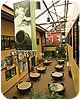
A sunlit atrium connects the old and the new building, and serves as a gathering place for employees.
Much of the work was done with sightseeing in mind. Visitors can easily look into windows highlighting the mechanical systems or look down into cutaways of the radiant floor. Candy-colored piping offers visual cues to the work, too. And along the hallways, various signs explain the details. If that isn’t enough, the new building’s conference rooms are named after the six recognized LEED building categories.
In its first full year of operations, a company brochure offers the following “efficiency scorecard” on the expansion:
- Reduced wastewater discharge by 26 percent or 25,000 gallons per year.
- Reduced potable water demand by 61 percent or 110,000 gallons per year.
- Saved 25 percent on estimated energy or $21,000 per year.
- Diverted 1,200 tons of construction waste that would have gone to landfills.
- Used 20 percent of total material cost as recycled material.
“There are some LEED points that don’t carry with them quite the same cost-benefit that the energy-related LEED points do,” Ahern adds. When the company executives planned the expansion, Ahern says a return on investment analysis - the exact same analysis they would offer clients - pointed toward which LEED points to pursue.
“If you start to think a little more long-term,” Ahern explains, “and you also start to couple the financial responsibility of your organization along with a sense of environmental stewardship that business leaders need today, then you can make a very compelling value proposition as to why you should build green.”
Since our focus is on plumbing, piping and heating, let’s take a look at what the company incorporated for those areas in the expansion. (See sidebar on “LEED Features” for a complete list of the expansion’s green construction systems and building techniques.)
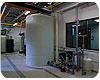
A 'greenwater' reclamation system flushes bathrooms throughout the new expansion.
Greenwater?
Well, we’ve seen it spelled “graywater” and we’ve seen it spelled “greywater,” so we think Ahern’s come up with a winner by calling its water reclamation system “greenwater.”We read before our office visit how the system uses rainwater to flush toilets and urinals, but we were a little surprised at its modest size when Craig W. Bahr, P.E., project manager, water/wastewater department, took us for a tour.
Of course, what we couldn’t see was the 20,000-gallon underground concrete cistern that collects rainfall from the roof before its treated and pumped into a 1,500-gallon storage tank on display.
Basically, what you can see represents two days’ worth of water for flushing fixtures in the new building’s bathrooms. Bahr explained that the rainwater goes through two different stages of filtration before finally being treated with ultraviolet light. While all that sounds like overkill for water destined to flush a toilet, Bahr says the treatment is still required by the state.
The greenwater system, along with, of course, the requisite low-flush toilets and urinals and low-flow faucets, saves the company 750 gallons of water every working day.
Although the greenwater system helps cut water and sewage bills, Bahr says one of the biggest advantages of the system was what the company didn’t have to spend money on. With it, Ahern didn’t have to run a water line to the expansion. Bahr says the system will pay for itself in 10 years.
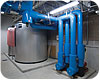
The 'icemaker' works at night when electricity rates drop by half and works in tandem with a traditional chiller.
The system works in tandem with a more traditional chiller system during peak daytime cooling hours. The ice system contributes about 40 tons of the needed 110 tons of cooling at peak demand. Bahr puts the payback at 3 1/2 years.
As for heating, radiant tubing runs along the perimeter of the building, an ideal place to augment heat in staff offices. Bahr can’t put a payback on the radiant system, but adds that the underfloor heat certainly helps lower overall heating bills without, more importantly, sacrificing everyone’s comfort during Wisconsin winters.
Talking with other Ahern executives during our visit underscored some of the peculiarities that we hear from plumbing contractors about the LEED point system. For example, we always hear the lament that you get a point for a bike rack, but nothing for an elaborate water reclamation system.
“Having special carpool parking spaces and a bike rack doesn’t mean people will carpool or ride their bikes to work,” adds Fischer. But everyone is going to flush a toilet during the day and expect to warm and cool throughout the year.
LEED officials typically counter the bike rack complaint by pointing out that all the points certainly do add up and that the system needs to be viewed from a step back in order to take in the integrated, whole building philosophy behind green building. Besides, plumbers might be interested in some of the changes LEED has promised starting next year for its water efficiency category.
The company is currently going through the process of securing LEED Gold status for the expansion. In the meantime, Ahern mentioned one LEED attribute that has much more to do with building a workforce than construction projects.
“Young people just graduating from either college or high school have grown up with the issue of green building,” he adds, “and I think it’s very important to promote our green building knowledge in order to attract people to our company. You want to be known as a good place to work and having a LEED-certified facility establishes that fact.”
We’ll second that opinion since it’s exactly how we ended up learning about this story. Last summer, we worked on a profile of a student chapter member of the Mechanical Contractors Association of America. At the time, he was hoping to be a finalist on the MCAA’s annual student chapter competition in which collegians work on a building proposal. This year’s project held at MCAA’s convention last March was based on Ahern’s green expansion.
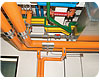
Colored pipe offers visual clues to office visitors touring the green expansion:
blue = chilled water
orange = heated water
green = domestic cold water
yellow = domestic hot water.
blue = chilled water
orange = heated water
green = domestic cold water
yellow = domestic hot water.
Leed Features
J.F. Ahern Co.’s new expansion contains plenty of other green building techniques and systems we don’t normally cover in Plumbing & Mechanical. For the record, here’s a full list of the building’s features, including a few details we mention in the main story, all under the six recognized LEED categoriesSustainable Site Development
Water Efficiency
Energy And Atmosphere
Materials And Resources
Indoor Environmental Quality
Innovation And Design
Leed 2009
Changes are in store for one of the biggest brand names in green construction. Last June, the U.S. Green Building Council announced a new version of its well-known Leadership in Energy and Environmental Design standards for new construction. Currently, the group has opened up the new version for public comment, but plans to put the new rules into place next January.Perhaps the biggest changes may help certify more buildings that are waiting for approval. As part of the changes, the USGBC’s sister agency, the Green Building Institute, would become an accreditation body and license third-party certifying organizations that could whittle down the backlog. According to the USGBC, more than 7,100 new construction projects are registered with LEED, but just over 1,000 are certified.
Another change would address “regionalizing” some of the LEED points. One criticism we’ve always heard about LEED is that there’s no “extra credit” for reducing water use in, say, Arizona. So, in other words, an Arizona project gets treated the same as a project in Chicago, where Lake Michigan looks pretty much like an ocean of fresh water.
Beyond those two changes, builders also will contend with an expanded point system - up to 100 points from the current 69 points - and tougher thresholds to reach the LEED levels.
“This is in keeping with the USGBC’s plan on trying to incrementally move the market toward higher performance goals with each revision of the rating system,” according to an analysis done by the Mechanical Contractors Association of America.
The points are also re-weighted to address areas that many consider more important. For example, the Water Efficiency points double to 10 points from five points. LEED 2009 also includes a new benchmark for buildings to reduce potable water use by 20 percent.
“The re-weighting can be seen as both a positive and a negative for MCAA contractors,” says the MCAA analysis. “Credits directly impacting plumbing contractors were doubled, but as a whole, water efficiency is still the smallest point category.” On the other hand, the LEED category for optimizing energy performance received the biggest point increase, so that’s good news for mechanical contractors installing heating and cooling systems. “However, with no additional points given for indoor environmental quality, five or six point credits directly impacting mechanical contractors were essentially given less significance.”
Looking for a reprint of this article?
From high-res PDFs to custom plaques, order your copy today!